Stellar Africagold - District-Scale Soil Sampling Defines Further Gold Exploration Targets At Zuenoula, Cote D'ivoire
(TheNewswire)
Vancouver, BC – March 11, 2026 – TheNewswire - Stellar AfricaGold Inc.
(“Stellar” or the “Company”) provides the following update on
the exploration progress at the Stellar-MetalsGrove Joint Venture
Zuénoula Gold Project, Cote d’Ivoire.
Highlights
-
The Fifty-Five Area, situated 1km
north of the Central Area see News Release
February 5, 2026), is defined by four gold
anomalous soil samples over a strike length of
2.4 km. Infill (400 m x 400 m) soil sampling of
a 10 km area has been
completed along the interpreted northeast (NE) structural trend. Assay
results are pending.
-
In the Central Area, infill soil sampling on a 400 m ×
400 m grid has been completed, with PortablePPB assay results
extending the strike length of the gold
anomalous sample cluster to 3.4 km. Assay
results are pending.
Stellar-MetalsGrove
Joint Venture Zuénoula Gold Project, Cote d’Ivoire.
The Stellar-MetalsGrove
Zuénoula Gold Project is a joint venture exploration project between
Stellar’s Ivorian subsidiary Aucrest SARL (“Aucrest”) and
MetalsGrove Mining Ltd. subsidiary, MetalsGrove CDI Pty Ltd
(MetalsGrove) to advance Stellar’s 395.78 square kilometer
early-stage exploration permit called Zuénoula in Côte d’Ivoire.
Pursuant to the joint venture agreement MetalsGrove, the project
operator, may earn up to a 50% interest in the Zuénoula Gold Project
by incurring US$3,000,000 in exploration expenditures and up to an 80% interest in the Zuénoula Gold Project by
incurring a total of US$6,000,000 in exploration expenditures.
(For further details of the Stellar-MetalsGrove
Joint Venture Agreement see Stellar news release December 9,
2025.)
Stellar Management
Commentary
Stellar President and
CEO J. François Lalonde commented:
“We are pleased with the pace of exploration by MetalsGrove at
the Zuénoula Gold Project and with the early results identifying now
three areas of anomalous gold in the soil
sampling. This is indeed very encouraging. I
extend our continuing thanks to the MetalsGrove exploration team on
this successful start.”
MetalsGrove Management
Commentary
MetalsGrove Managing
Director and CEO, Mr Lijun Yang, commented:
“The identification of
a second gold target at the Fifty-Five
Area highlights the scale and growing
prospectivity of our Zuénoula PR750 permit. With soil sampling
already infilled on a 400 m × 400 m grid and with all assay results
pending, we are rapidly advancing this emerging target while
continuing to expand the footprint of gold anomalism at the Central
Area.
The recent PortablePPB
results from the Central Area have extended the gold anomalous strike
length to 3.4 km and the area of infill sampling increased to 20
km2 to capture the
potential northeastern extension of this northeast-trending zone of
gold anomalism. All infill sampling has been completed. Fire assay
results from MSALabs in Yamoussoukro will provide a more definitive
assessment of gold tenor and support detailed 100 m × 50 m follow-up
sampling aimed at planning drill targets.”
Zuénoula Soil Sampling
Update
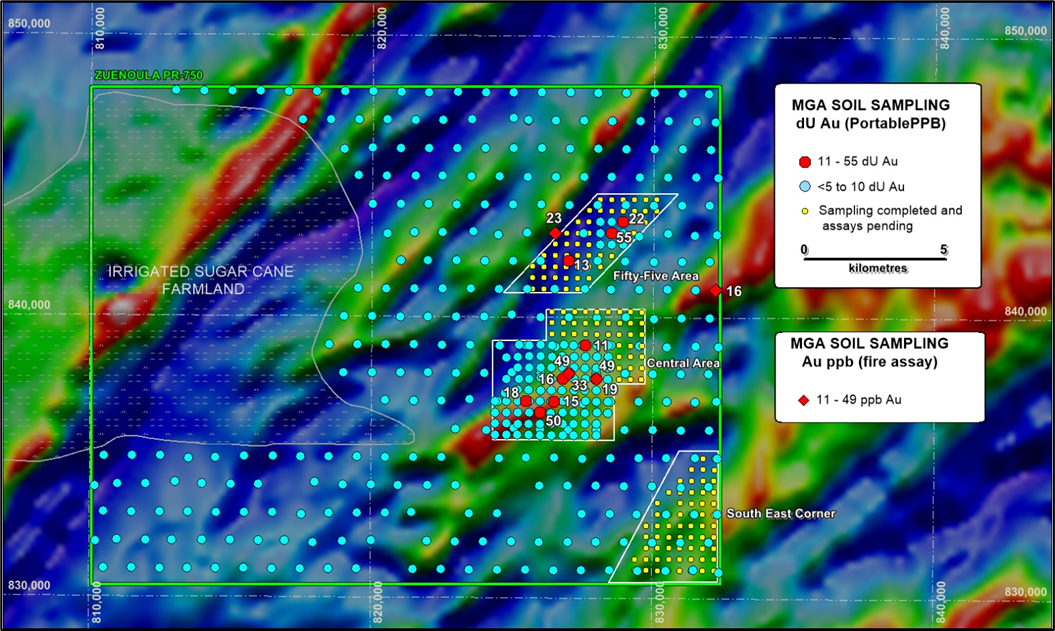
Stellar is pleased to
announce is pleased to announce that work on the Zuénoula permit has
defined three exploration target areas that have been infilled with
soil samples on 400m × 400m grids (Figure 1). Assay results are
pending.
1.
The Fifty-five Area: A
northeast-trending alignment of three gold anomalous soil samples (11
- 55dU) extends over 2.4km within a 10 km2 area. Limited fire assay analysis
also returned a soil sample assaying 23ppb Au. Infill sampling (400m x
400m) has been completed, and samples will be transported to Bureau
Veritas in Abidjan for fire assay analysis of all samples this
week.
2.
The Central Area: A
northeast-trending alignment of seven gold anomalous soil samples (11
- 50dU) extends over 3.4km within a 20 km2 area. Limited fire assay analysis
returned soil samples assaying 49ppb Au (PortablePPB 33 dU) and 49 ppb
(PortablePPB 19dU). Infill sampling (400m x 400m) has been completed,
and samples will be transported to Bureau Veritas in Abidjan for fire
assay analysis of all samples this week. A geologist is also currently
mapping and collecting rock-chip samples for analysis.
3.
The South East Corner: A
favourable structural target located along contact of an interpreted
elliptical granite has been covered by higher
density sampling even though broad-spaced 1km x 1km soil samples did
not return anomalous soil assays. Infill sampling (400m x 400m) has
been completed, and samples will be transported to Bureau Veritas in
Abidjan for fire assay analysis of all samples this week.
Click Image To View Full Size
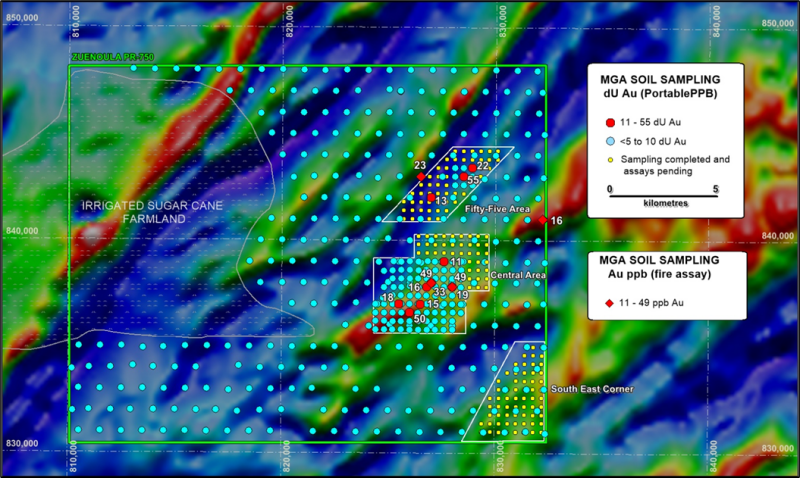
Figure 1. Zuénoula soil
sampling progress and
exploration targets (3)
on aeromagnetic image (RTP)
The Fifty-Five Area, located
1km north of the Central
Area, is defined by four gold anomalous soil
samples over a strike length at 2.4 km.
Infill (400 m x 400 m) soil sampling of a
10 km² area has been
completed along an interpreted northeast (NE) structural trend. All
infill soil assay results are pending.
Infill sampling of the initial 13km2
Central Area has been
completed on a 400 m × 400 m grid and PortablePPB assays received
(Figure 1). These results further increase the strike-length of the
Central Area gold
anomalous cluster (trend) to 3.4km. The Central Area has now been expanded to 20km2 to cover
the NE-strike of this potential gold anomalous trend. Sampling has
been completed and assay results are pending.
Infill soil sampling of the South
East Corner Area on a 400 m × 400 m grid to
investigate a favourable structural target located along the margin of
an interpreted elliptical granite intruded into mafic volcanics has
also been completed. Assay results are pending.
All Fifty-five Area, Central Area
and South East Corner infill soil samples
will soon be delivered to
Bureau Veritas in Abidjan for fire assay determination
of gold. Coherent gold anomalous zones defined by these fire assay
results will then be used to plan the final stage of infill, with
soils collected on a 100m × 50m grid. This density of sampling is
required for target definition and drill hole planning.
About the Zuénoula Gold Project
The Stellar-MetalsGrove Zuénoula Gold Project is a
joint venture exploration project between Stellar’s Ivorian
subsidiary Aucrest SARL (“Aucrest”) and MetalsGrove Mining Ltd.
subsidiary, MetalsGrove CDI Pty Ltd (MetalsGrove) to advance
Stellar’s 395.78 square kilometer early-stage exploration permit in
Côte d’Ivoire. The Zuénoula permit is
strategically situated along the Abujar–Napié
gold trend within the Oumé–Fetekro Birimian
greenstone belt in central Côte d’Ivoire, 100km north of the Abujar Gold Mine and
160 km south of the Napié Gold
Deposit.
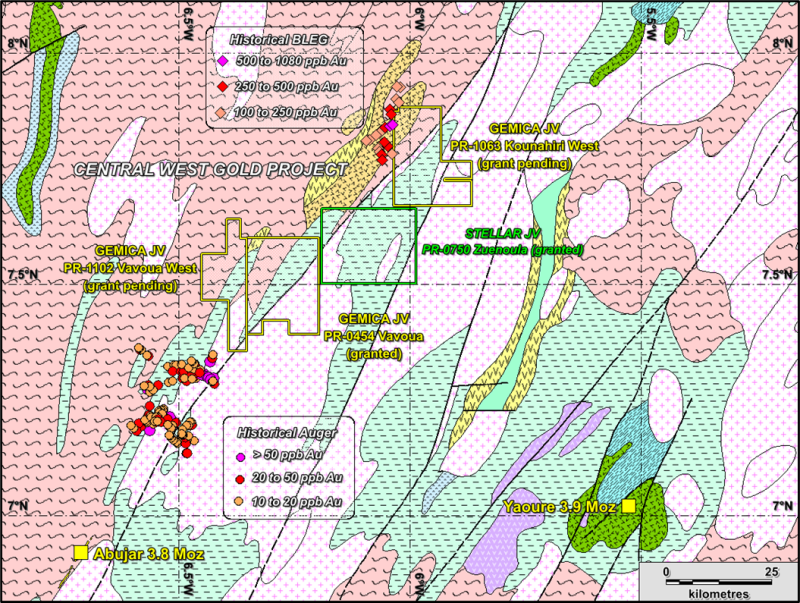
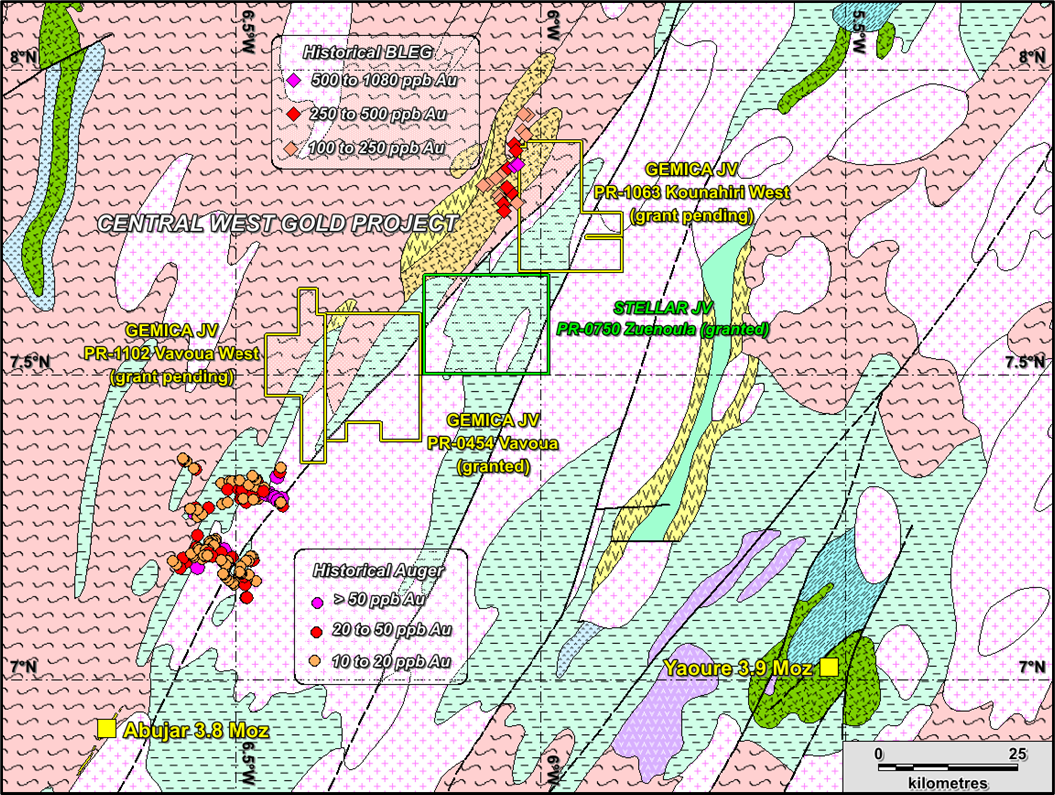
Click Image To View Full Size
Figure 2. Geology Map of
the Central West Gold Project and Historical Exploration
Results1
1 Historical BLEG results sourced from African Gold Limited
Annual Report 2023; Historical Auger drilling result sourced from
Ricca Resources Limited Financial Report for half year ending 31
December 2021.
QA/QC
JORC Code, 2012 Edition – Table 1
Section 1- Sampling Techniques and Data
|
Criteria
|
JORC Code Explanation
|
Commentary
|
|
Sampling Techniques
|
-
Nature and quality of sampling (e.g. cut channels,
random chips, or specific specialied industry
standard measurement tools appropriate to the minerals under
investigation, such as downhole gamma sondes, or
handheld XRF instruments, etc.) These examples should not be taken as
limiting the broad meaning of sampling.
-
Include reference to measures taken to ensure sample
representivity and the appropriate calibration of any measurement
tools or systems used.
-
Aspects of the determination ofmineralisation that are Material to the Public
Report.
In cases where ‘industry standard’ work has been
done, this would be relatively simple (e.g. ‘reverse circulation
drilling was used to obtain 1 m samples from which 3 kg was pulverised
to produce a 30 g charge for fire assay’). In other cases, more
explanation may be required, such as where there is coarse gold that
has inherent sampling problems. Unusual commodities or mineralisation
types (e.g. submarine nodules) may warrant disclosure of detailed
information.
|
No drilling has been undertaken on Vavoua PR-454.
Soil samples collected for Vavoua PR-454 are to be
assayed by fire assay at Bureau Veritas laboratory in Côte
d’Ivoire, and selected samples analyses by PortablePPB at the SEMS
field compound in Zuénoula.
SOIL SAMPLING STAGES
-
Stage 1: Initial, permit-wide,
broad-spaced soil sampling on an 800m x 800m grid
-
Stage 2: Gold anomalous clusters
and trends defined by multiple anomalous soil samples are then
infilled with soil samples collected on 400m x 400m grid.
-
Stage 3: Coherent gold soil
anomalies are then infilled with soil samples collected on a 100m x
50m grid
-
All samples are to be analysed by fire assay at Bureau
Veritas laboratory in Côte
d’Ivoire, with selected samples analysed by
PortablePPB at the SEMS compound in Zuénoula.
-
The assay results from this higher-density sampling
(100m x 50m) permit trenching and drilling to be planned.
SOIL SAMPLING PROCEDURES
-
The highly experienced consulting group SEMS
Exploration Services (SEMS) has been contracted by MGA to conduct the
soil sampling
-
Up to 4 sampling crews may be active
-
The MGA Exploration Manager was onsite at the start of
the field program to instruct the sampling crew on the Standard
Sampling Procedure required by MGA
-
MGA provided SEMS Exploration Services with an Excel
table listing the designated sample point locations using WGS-84 UTM
zone 29N coordinates
-
Each soil sample is collected from within 50 metres of
the designated sample point, with the actual sample point then
recorded
-
At each sample point: 1) the organic rich soil is
brushed away, 2) a 40cm deep hole dug and the sample collected by
taking a channel-cut along the bottom 20cm of the hole, 3) 1000g of
the minus 2mm sieved fraction of each sample is collected from the
sample point, 4) gold is determined by fire assay (LDL 2ppb) and
with selected samples also analysed by PortablePPB (LDL ~6dU
)
-
Duplicate samples are collected every 20th sample,
certified reference material (CRM) inserted every 20th samples and
blanks inserted every 20th sample
-
PortablePPB is a partial gold extraction technique,
whereas fire assay is a total gold extraction technique
-
Samples are processed and stored at the secure SEMS
field compound in Zuénoula.
|
|
Drilling Techniques
|
-
Drill type (e.g. core, reverse circulation, open-hole
hammer, rotary air blast, auger, Bangka, sonic, etc.) and details
(e.g. corediameter,tripleorstandard
tube,depthofdiamond tails, face-sampling bit or other type, whether core
is oriented and if so, by what method, etc).
|
|
|
Drill Sample Recovery
|
-
Method of recording and assessing core and chip sample
recoveries and results assessed.
-
Measures taken to maximise sample recovery and ensure
representative nature of the samples.
-
Whether a relationship exists between sample recovery
and grade,andwhether
samplebias may have occurred due to preferential
loss/gain of fine/coarsematerial.
|
|
|
Logging
|
-
Whether core and chip samples have been geologically
and geotechnicallyloggedtolevel of detail to support
appropriate Mineral Resource estimation, miningstudiesandmetallurgical studies.
-
Whether loggingisqualitativeor quantitative in nature.
Core (or costean, channel, etc.) photography.
-
Thetotallengthandpercentage oftherelevantintersections logged.
|
-
No drilling has been undertaken.
-
Soil samples are comprehensively logged for a range of
parameters including colour, soil horizon, sample weight, slope,
dominant grain size (clay, silt, sand), general topography, residual
or transported, proximity to artisanal workings, other ground
disturbances such as field plowing, and general land use (grassland,
plantation, crop, etc.).
|
|
Sub-sampling Techniques
and Sample Preparation
|
-
Ifcore,whethercutorsawnand whether
quarter, half or all core taken.
-
Ifnon-core,whetherriffled,tube sampled, rotary split, etc. and whether sampled wet or
dry.
-
For all sample types, the nature, quality and
appropriateness of the sample preparation technique.
-
Quality control procedures adopted for all sub-sampling
stagestomaximise
representivity of samples.
-
Measures taken to ensure that thesamplingisrepresentativeof the in-situ material
collected, including, for instance, results for field
duplicate/second-half sampling.
-
Whethersample sizes are appropriate to the grain size of
the material being sampled.
|
-
No drilling has been undertaken.
-
The 1000g -2mm soil fraction collected in the field is
riffle split at the SEMS field compound in Zuénoula into two 500g
sub-samples
-
Selected 500g sub-samples are analysed by
PortablePPB
-
All 500g sub-samples are analysed by fire assay at
Bureau Veritas in Abidjan
|
|
Quality of Assay Data and Laboratory Tests
|
-
The nature, quality and appropriateness of the assaying
andlaboratoryproceduresused and whether the
technique is considered partial or total.
-
Forgeophysical tools,
spectrometers, handheld XRF
instruments,etc.,theparameters used in determining the
analysis, including instrument make and model, reading times,
calibrationfactorsapplied,and
their derivation, etc.
-
Nature of quality control procedures adopted (e.g.
standards, blanks, duplicates, externallaboratorychecks)and whether acceptable levels of accuracy (i.e. lack of bias)
and precision have been
established.
|
PORTABLE-PPB ANALYSIS
-
Selected 500g sub-samples are analysed using the
patented detectORE™ process developed by Portable PPB Pty Ltd in
Australia
-
The process involves a partial extraction using the
safe, non-dangerous GLIX-20® reagent that is akin to traditional BLEG
(which uses a cyanide leach)
-
The 500g samples are added to the reagent and tumbled
for 12 hours, into which the detectORE™ collector device had been
inserted
-
After the bottle roll process has completed, the
collector device is removed, washed, and dried prior to reading on a
Vanta M (VMR) pXRF loaded with Evident/Olympus’s detectORE™
mode
-
The entire process is managed using Portable PPB’s
Portable Lab Information Management System (pLIMSTM), which records
all aspects of the sample throughput, including QAQC and control of
the pXRF via the Application Programming Interface to
Olympus/Evident’s co-developed detectORE™ mode.
-
Certified Collector Devices (CCDs) supplied by
PortablePPB with known quantities of gold ranging from 0 -1000 ppb are
used to check that the pXRF was functioning correctly and that the
instrument settings were as intended. One CCD serves as a blank.
-
The pLIMS software confirmed the instrument settings
are correct and the VMR is operating as expected, controlled by the
pLIMS API and Evident’s detectORE™ firmware.
|
|
Verification of Sampling
and Assaying
|
-
The verification of significant intersections by either
independent or alternative company personnel.
-
Theuseoftwinnedholes.
-
Documentationofprimarydata, data entry procedures,
data verification, data storage (physical and electronic) protocols.
-
Discussanyadjustmentstoassay data.
|
-
The detectORE™ process is checked in accordance with
PortablePPB’s recommended processes and procedures. These include
the insertion of 400g reference materials (RMs).
-
The RMs comprise mixtures of commercial Certified
Reference Materials (CRMs) and barren regolith material. The RMs are
of known, but uncertified gold concentration and are used to check
that the leach and collect process has worked as intended during the
12-hour bottle roll.
-
RMs were inserted at a rate of 1 every 44 samples
throughout the sample batches. The RMs were checked against Portable
PPB’s cloud-based database and passed within the accepted tolerance
ranges for the technique, currently 20% (3 sigma).
-
The pXRF instrument settings are checked using a range of Certified Collector Devices, which are used
to confirm the pXRF is operating as expected. The pXRF spectral files
are reviewed by Portable PPB’s cloud and SME procedures.
FIRE ASSAY ANALYSIS
-
All samples are analysed for gold by fire at Bureau
Veritas laboratory in Cote d’Ivoire
-
The original 1000g -2mm sample collected in the field
is split into two 500g sub-samples using a riffle splitter. One 500g
sub-sample is kept as a reference sample and may be used for
PortablePPB analysis. The second 500g sub-sample is used for gold
analysis by fire assay (Lab Code: FE450, LDL 2ppb)
-
At the laboratory, the 500g -2mm sub-sample is dried
and pulverised to 85% passing 75 microns.
-
This sample pulp is then mixed with a combination of
chemical reagents, which when heated to high temperatures results in
the formation of a lead button and slag. The lead button that contains
the precious metals (including gold) is cupelled at high temperature.
The lead is adsorbed by the cupel leaving behind a bead that contains
the precious metals.
-
The bead is acid digested and analysed by AAS, with a
lower detection limit of 2ppb Au
|
|
Location of Data Points
|
-
Accuracy and qualityof surveys
used to locate drillholes (collar and down-hole surveys), trenches,
mine workings and other locations used in Mineral Resource
estimation.
-
Specification of the grid system used.
-
Quality and adequacy of topographic control.
|
-
A handheld GPS is used to locate the soil data
positions, with a +/-5m vertical and horizontal accuracy
-
Sample locations (UTM WGS-84 zone 29N) and sample
descriptions are noted on a standard form in the field and entered on
a computer of an evening
-
GPS measurements of sample positions are sufficiently
accurate for exploration targeting of gold systems.
|
|
Data Spacing and Distribution
|
-
Data spacing for reporting Exploration
Results.
-
Whether the data spacing and distribution is sufficient
to establish the degree of geologicalandgradecontinuity appropriate for the Mineral Resource and Ore
Reserve estimation procedure(s) and classifications applied.
-
Whethersamplecompositing hasbeenapplied.
|
-
An 800m by 800m offset grid pattern has been adopted
for the entire project area, excluding areas of irrigated sugar cane
and villages.
-
Broad-spaced soil sampling (800m by 800m) and low level
gold fire assay analysis (LDL 2ppb) is considered an effective
technique for identifying and delimiting gold anomalous clusters and
trends, which are then followed up with higher density sampling at
400m 400m and 100m x 50m as the next phases of
sampling ahead of trenching and drill testing of coherent gold soil
anomalies.
|
|
Orientation of data in relation
to geological al
structure
|
-
Whether the orientation of sampling achieves unbiased
sampling of possible structures and the extent to which this is known,
considering the deposit type.
-
If the relationship between the drilling orientation
and the orientation of key mineralised structures is considered to
have introduced a sampling bias, this should be assessed and reported
if material.
|
|
|
Sample security
|
|
-
1000g of the -2mm sieved fraction of soil samples are
collected in plastic bags, assigned individual sample numbers and
transported to the secure SEMS lab and compound in Zuénoula
-
Samples are analysed by fire assay at Bureau Veritas in Côte d’Ivoire and are personally transported to the laboratory by a senior
member of the SEMS crew.
|
|
Audits or Reviews
|
|
-
The sampling and assay techniques adopted by
MetalsGrove has been effectively used in the Vavoua-Kounahiri
district, and more widely in Cte d’Ivoire, to
define drill targets and it is considered an effective initial
approach for defining gold anomalous lithogeochemical trends.
|
Section 2 - Reporting of Exploration Results
(Criteria listed in the preceding section also apply to
this section.)
|
Criteria
|
JORC Code Explanation
|
Commentary
|
|
Mineral Tenement and Land
Tenure Status
|
-
Type, reference name/number, location and ownership,
including agreements or material issues with third parties such as
joint ventures, partnerships, overriding royalties, native title
interests, historical sites, wilderness or national park and
environmental settings.
-
The security of the tenure held at the time of
reporting, along with any known impediments to
obtaining a licence to operate in the area.
|
-
Following the acquisition of the three GEMICA joint venture (JV) permits
PR-454 (granted), PR-1063 (application) and PR-1102 (application) in
Côte d’Ivoire, MetalsGrove entered into another JV with TSX-V
listing company Stellar AfricaGold Inc. (Stellar) on PR-750 Zuénoula.
-
Vavoua PR-454 was granted on 3 Dec 2025 for an initial
four-year period, renewable for two additional
three-year periods.
-
The Vavoua permit is located with Kounahiri West,
Vavoua West and Zuénoula permits occupy a combined area of 1,315
km², strategically situated along the Abujar–Napie gold trend
within the Oumé–Fetekro Birimian greenstone belt in
central west of Côte
d’Ivoire, approximately 100 km north of the Abujar gold mine and 160
km south of the Napié gold project.
|
|
Exploration Done by Other Parties.
|
|
|
|
Geology
|
|
-
The Vavoua, Vavoua West, Kounahiri West and Zuénoula
permitsare located in the central west of Côte
d'Ivoire at the south edge of the West Africa craton. This region
is the world’s largest Proterozoic gold-producing region, and
Cte d’Ivoire contains 35% of the region’s
Birimian Group rocks, which host multiple multi-million-ounce gold
deposits
-
The GEMICA JV permits and Stellar JV permit, together cover a combined
area of 1,315 km², and are strategically situated along the
Abujar–Napié gold trend within the Oumé–Fetekro Birimian
greenstone belt, and are located approximately 100 km north of the
Abujar gold mine and 160 km south of the Napié gold project.
|
|
Drillhole Information
|
-
A summary of all information material to the
understanding of the exploration results, including a tabulation of
the following information for all Material drill holes:
-
easting and northing of the drillhole collar elevation
or RL (Reduced Level – elevation above sea level in metres) of the
drillhole collar dip and azimuth of the hole
-
down hole length and interception depth hole
length.
|
|
|
Data Aggregation Methods
|
-
In reporting Exploration Results, weighting averaging
techniques, maximum and/or minimum grade truncations (e.g., cutting of
high grades) and cut-off grades are usually Material and should be
stated.
-
Where aggregate intercepts incorporate short lengths of
high-grade results and
longer lengths of low-grade results, the procedure used for such
aggregation should be stated, and some typical examples of such
aggregations should be shown in detail.
-
The assumption used for any reporting of metal
equivalent values should be clearly stated.
|
|
|
Relationship Between
Mineralisation Widths and
Intercept Lengths
|
|
|
|
Diagrams
|
-
Appropriate maps and sections (with scales) and
tabulations of intercepts should be included for any significant
discovery being reported. These should include, but not be limited to,
a plan view of drillhole collar locations and appropriate sectional
views.
|
|
|
Balanced Reporting
|
-
Where comprehensive reporting of all Exploration
Results is not practicable, representative reporting of both low and
high grades and/or widths should be practied, avoiding misleading reporting of Exploration Results.
|
|
|
Other Substantive Exploration Data
|
-
Other exploration data, if meaningful and material,
should be reported, including (but not limited to): geological
observations; geophysical survey results; geochemical survey results;
bulk samples – size and method of treatment; metallurgical test
results; bulk density, groundwater, geotechnical and rock
characteristics; potential deleterious or contaminating
substances.
|
|
|
Further Work
|
-
The nature and scale of planned further work (e.g.
tests for lateral extensions, or depth extensions, or large-scale
step-out drilling).
-
Diagrams clearly highlighting the areas of possible
extensions, including the main geological interpretations and future
drilling areas, provided this information is not commercially sensitive.
|
-
Soil sampling has also commenced on adjoining
MGA-Stellar JV permit PR750 Zuénoula
-
Soil sampling will commence on adjoining permits PR1063
and PR1102 once decree of grant has been issued by the Government of
Cte d'Ivoire
-
The images included in this announcement show the location of soil sample sited, sampled and planned,
in the current programs.
|
Qualified Person
The technical information contained in this release has
been reviewed and approved by Mr. Robert Perring, a current member of
the Australian Institute of Geoscientists (MAIG) and Exploration
Manager of MetalsGrove Mining Limited. Mr Perring is a Qualified Person under National
Instrument 43-101.
About Stellar Africagold Inc.
Stellar AfricaGold Inc. is a Canadian precious metal
exploration company focused on precious metals
in North and West Africa, with active programs in
Morocco and Côte d’Ivoire. Stellar’s principal exploration
projects are its advancing gold discovery at the Tichka Est Gold
Project in Morocco, and its
early-stage exploration Zuénoula Gold Project in Côte
d’Ivoire which is operated in Joint venture with MetalsGrove Mining
Ltd subsidiary, MetalsGrove CDI Pty Ltd.
The Company is listed on the TSX Venture Exchange
symbol TSX.V: SPX, the Tradegate Exchange TGAT: 6YP and the Frankfurt
Stock Exchange FSX: 6YP.
The Company maintains its head office in Vancouver, BC
and has a country office in Marrakech, Morocco.
Stellar’s President and CEO J. François Lalonde can
be contacted at +1 514-9940654 or by email at lalondejf@stellarafricagold.com
Additional information
is available on the Company’s website at www.stellarafricagold.com.
On Behalf of the Board
J. François Lalonde
President & CEO
This news release
contains “forward-looking statements” within the meaning of
applicable Canadian securities laws, including statements regarding
the grant of PSUs, the potential vesting of such PSUs upon the
achievement of future production milestones, the issuance of common
shares of the Company upon settlement of vested PSUs, and the
acceptance of the TSX Venture Exchange.
Forward-looking
statements are based on expectations, estimates and projections as at
the date of this news release and are subject to known and unknown
risks, uncertainties and other factors that may cause actual results
or events to differ materially from those expressed or implied. Such
risks and uncertainties include, but are not limited to, the Company
not achieving the production milestones described herein, changes in
business plans or commodity prices, failure to obtain regulatory
approvals, and the risk factors described in the Company’s most
recent Management’s Discussion and Analysis and Annual Information
Form, which are available on SEDAR+ at www.sedarplus.ca.
Forward-looking
statements are not guarantees of future performance and should not be
unduly relied upon. Except as required by law, the Company undertakes
no obligation to update or revise any forward-looking statements
contained herein.
Neither the TSX Venture
Exchange nor its Regulation Services Provider (as that term is defined
in the policies of the TSX Venture Exchange) accepts responsibility
for the adequacy or accuracy of this release.
Copyright (c) 2026 TheNewswire - All rights reserved.