


Toronto, Ontario--(Newsfile Corp. - December 1, 2025) - American Eagle Gold Corp. (TSXV: AE) (OTCQB: AMEGF) ("American Eagle" or the "Company") is pleased to announce a series of broad copper-gold mineralized intercepts from drill holes collared within the Babine Porphyry Stock ("BPS"), east of the Company's primary drilling focus at the NAK property ("NAK"). These results outline a new mineralized zone in an underexplored part of the property, an area previously regarded as largely unmineralized and point to a meaningful opportunity to expand the project's overall footprint.
Highlighted by an intersection in the BPS, there is over 900 meters of continuous copper and gold mineralization starting from surface. Our view of the BPS has evolved significantly, not only based on these new results, but also from other visual observations, such as those in NAK25-59, referenced in the September 25 news release. While assays NAK25-59 are still pending, the hole exhibited clear visual mineralization. These observations contribute to our growing understanding of the overall system, including the BPS and other mineralized zones within NAK.
Highlights:
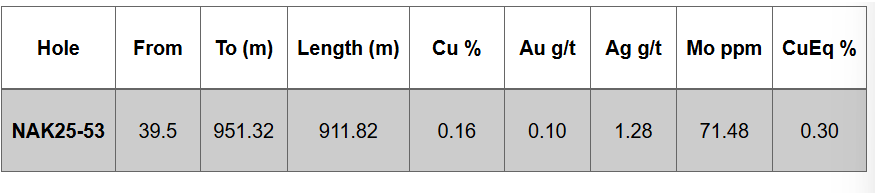
Strong Continuity of Grades Within the BPS: NAK25-53 returned consistent mineralization from top to bottom, delivering 911 m of 0.30% CuEq.
BPS Confirmed as Mineralized: The BPS is now shown to host meaningful grades. Drill holes NAK25-53, -56, -58, and -60 all returned strong results, and follow-up holes show similar visual and portable pXRF copper indications. Taken together, these data suggest a substantial volume of well-mineralized material in this newly defined area east of the historical North Zone, potentially forming part of a continuous system.
New Zone Remains Open: Ongoing drilling indicates that the mineralized area remains open to the east, northeast, and southeast, supporting potential for further expansion.
Exploration Update: Approximately 3,000 meters remain to be drilled for the Company's 30,000-meter target for the 2025 season. The three rigs currently in operation are concentrated on different areas of the NAK property: the historical South zone, the IP Embayment zone, and the Babine porphyry stock. An estimated 44 holes will be drilled by the end of the 2025 season, with 29 additional holes to be assayed and released throughout 2025 and into 2026.
Results for holes drilled in the South zone will be released in the next two weeks.
See plan map of 2026 drill holes to date
"These new results highlight the growth potential and scale of the NAK system. What sets NAK apart is not only its scale, but also the discovery of new zones of mineralization. In addition to the property's excellent geography, proximity to infrastructure, low-lying elevation, and favorable topography, these factors make it ideal for a bulk-tonnage project. At the same time, we continue to identify higher-grade parts of the system that add to the near-surface high-grade intersections of the South zone, which is becoming an expanding center of gravity," said Anthony Moreau, CEO of American Eagle Gold.
Geological Setting and Significance
The easternmost hole described in this release, NAK25-53, was drilled within the largely underexplored Babine porphyry stock, which was previously viewed as largely unmineralized. In contrast, however, NAK25-53, along with a long interval at the bottom of NAK25-58, and the top of NAK25-60, yielded lengthy intervals of economic-grade mineralization, with hole NAK25-53 returning over 900 meters of 0.3% CuEq hosted almost entirely within the porphyry stock. Consequently, it has become clear that the stock itself represents a valid exploration target for "North Zone-style" mineralization, where late and commonly very well mineralized dykes with distinctive textures and alteration signatures cut the typical biotite feldspar porphyry of the stock.
The geological framework of the area is complex in detail but can be summarized by a chronology constrained by cross-cutting relationships among a number of distinct intrusions, including the Babine porphyry stock, by associated mineralization, and by related alteration assemblages that may affect both the intrusions and their host stratified rocks, which are largely sedimentary.
The intrusive system and related mineralization and alteration can be simplified and viewed as occurring in three stages: Early, Middle and Late
The Early-stage is defined by dark-colored, magnetite-biotite altered dykes and diorite that mineralize and alter the surrounding sedimentary rocks.
The Middle-stage is marked by emplacement of the Babine porphyry stock, which is younger, less altered, and paler colored than the Early stage and dark colored biotite magnetite bearing intrusions.
The Late-stage intrusions consist of Seriate Dykes ("DSE") and Copper Dykes ("DC"), typically very pale colored, phyllically altered and commonly associated with another significant pulse of mineralization, chiefly of chalcopyrite and bornite.
The late-stage intrusions and mineralization crosscut and affect all the earlier phases of intrusions, mineralization and alteration, including the Babine stock and the earlier dark colored dykes. While the geology may appear complex due to the number of intrusions, their compositional variation, and the overprint of mineralization and alteration, understanding their relationships is critical, as porphyry mineralizing systems are driven by the intrusions.
What our current understanding strongly suggests, is that the Babine porphyry stock acts primarily as wall rock to the Late stage DSE-DC and the associated mineralization in the drill holes reported on in this release. These dykes, although at times narrow, and although at times perhaps only nearby the drill hole traces, represent the intrusive system that drives the hydrothermal solutions from which the mineralization is deposited. What is particularly exciting about the Nak system, is that we have likely not yet hit the better part of the Late-stage system on the property.
View Core Photos for Released Holes
NAK25-53 Assay Results (Table 1) and Details*
View Cross Section
NAK25-53 was collared 160 m northeast of NAK22-06 and drilled at a steep inclination to the west. It represents the easternmost collar location for drill holes released to-date within the NAK Main zone, which links the historical South (Stockwork) and North (Copper) zones. Within the Main zone at NAK, and particularly within the north end of the Main zone, the strongest mineralization to date has almost exclusively been encountered to the west of crowded (hornblende) biotite feldspar porphyritic rocks of the Babine porphyry stock, mainly in sandstone and conglomerate outboard of the stock, but also in early and similarly altered dikes. NAK25-53, in contrast, was collared into, and remained entirely within, intensely sericite altered rocks of the stock, and in younger, cross-cutting seriate textured monzonitic dykes (the DSE-type dykes). Mineralization consisted of common stringer style chalcopyrite-bornite-molybdenite veining, along with local zones of disseminated chalcopyrite which replaces mafic sites (likely biotite) in the intrusions, and locally within the Babine porphyry wallrocks. In addition, two notable intercepts of bornite-bearing sparsely plagioclase phyric monzonitic dykes were also encountered. These occur deeper than 800m down hole, and they returned among the strongest grades in the hole.
The discovery of continuous, moderate to strong mineralization within the Babine porphyry stock suggested strongly that excellent potential remains eastward from the Main zone within the largely untested one-kilometre square region inferred by previous workers to be underlain by similar rocks. As a result, crude fence of drill holes extending a further 300 meters eastward into that area has been drilled and sampled, and the Company is awaiting the results of assaying.
NAK25-56 Assay Results (Table 2) and Details*

View Cross Section
NAK25-56 was drilled 200 m to the south of NAK25-53, and inclined to the west, testing an under-drilled area of the central part of the Main zone. NAK25-56 collared into crowded (hornblende) biotite feldspar porphyry of the Babine porphyry stock, which intrudes fine- to coarse-grained sandstone hosting increased disseminated chalcopyrite. Farther downhole, mineralization was strongest between 381 and 597 m down hole in conglomerate, consisting of veins and local clast and/or matrix replacements by disseminated chalcopyrite and/or bornite.
Below the well-mineralized conglomerate, grades were patchy, with local zones of densely disseminated chalcopyrite but with a generally increasing abundance pf pyrite westward and to depth.
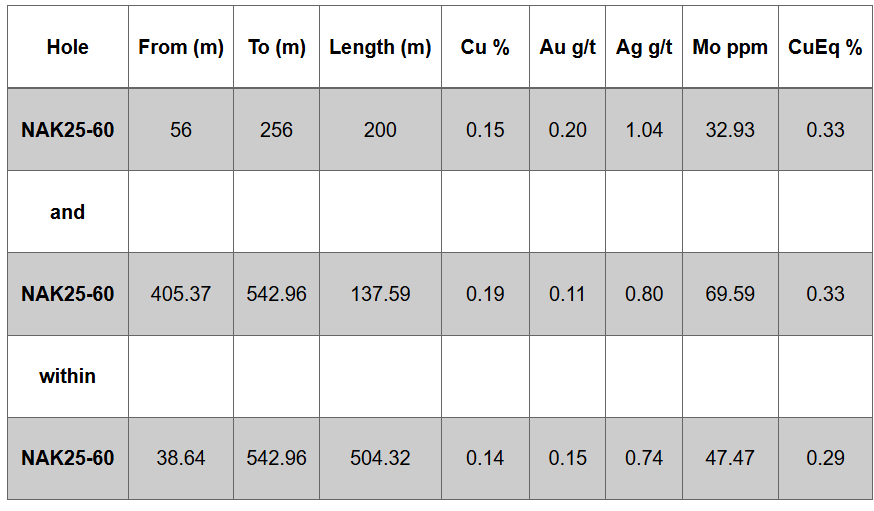
NAK25-60 Assay Results (Table 3) and Details*
View Cross Section
NAK25-60 was collared 160 m north of NAK22-01 and was designed to test the northern extent of the near surface gold-rich mineralization in the historical South (or Stockwork) zone. In keeping with the targeting strategy outlined in NAK25-56, this hole was drilled to the west and was successful in showing continuity of moderate grade mineralization from surface down to a down-hole depth of 543 meters. NAK25-60 collared into intrusive rocks of the Babine porphyry stock that hosted sparse quartz stockwork veins and fracture coatings with chalcopyrite and trace bornite; these are characteristic mineralization at the South zone.
At approximately 85 m depth, the hole crossed the contact of the porphyry stock into fine- to coarse-grained sandstone, and from a depth of 200 meters until the end of the hole, it intersected conglomerate. Mineralization in the sedimentary rocks was a mix of vein-hosted and disseminated chalcopyrite (+/- bornite), with the strongest mineralization hosted in the upper 50 m of the conglomeritic unit. Like NAK25-56, this hole improves upon the grade profile defined by the generally easterly inclined and/or steeper drill holes drilled in previous years at this latitude, raising questions about the best orientation for drill testing and suggesting opportunities for shallower drilling.
NAK25-58 Assay Results (Table 4) and Details*

View Cross Section
NAK25-58 was collared from the same location as NAK25-56 and drilled to the north. The drill hole was designed to traverse from poorly mineralized Babine porphyry stock known to occur in the vicinity of the collar to better mineralized stock rocks encountered to the north in NAK25-53. Like NAK25-53, this hole remained largely within rocks of the Babine porphyry stock, crosscut mainly by relatively narrow intervals of seriate textured dykes, particularly in its lower reaches where the hole was better mineralized.
At a depth of 275 m, mineralization sharply increased in abundance, with irregular stringer veins and local disseminated chalcopyrite (+/- bornite and molybdenite), with the strongest zone of mineralization between 400 and 643 m down hole.
* Copper Equivalent (CuEq) shown in Tables for drill intercepts are calculated on the basis of US$ 3.75/lb for Cu, US$ 1,900/oz for Au, US$ 25/oz for Ag and US$ 25/lb for Mo, with 80% metallurgical recoveries assumed for all metals (since it's unclear what metals will be the principal products, assuming different recoveries is premature at this stage). The formula is: CuEq. = Cu % + (Au grade in g/t x (Au recovery / Cu recovery) x [Au price ÷ 31] / [Cu price x 2200]) + (Ag grade in g/t x (Ag recovery / Cu recovery) x [Ag price ÷ 31] / [Cu price x 2200] + (Mo grade in % x (Mo recovery / Cu recovery) x [Mo price x 2200] / [Cu price x 2200]). The assays have not been capped.
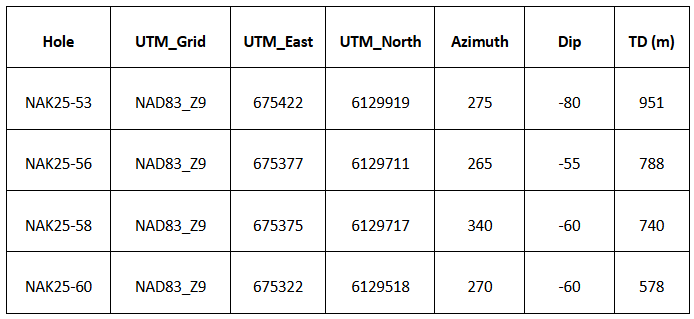
Collar details for holes in this release (table 5):
QA/QC and Sampling Protocol
Sampling at NAK follows a rigorous methodology and internal QA/QC protocol. Drill core is halved on site, and samples are submitted to ALS Geochemistry in Langley, British Columbia for preparation and analysis. ALS is accredited to the ISO/IEC 17025 standard for assays. All analytical methods include quality control standards inserted at set frequencies. The entire sample interval is crushed and homogenized, and 250 g of the homogenized sample is pulped. All samples were analyzed for gold, silver, copper, molybdenum and a suite of 45 other major and trace elements. Analysis for gold is by fire assay fusion followed by Inductively Coupled Plasma Atomic Emission Spectroscopy (ICP-AES) on 30 g of pulp. Analysis for silver, copper, and molybdenum and all other major and trace elements are analyzed by four-acid digestion followed by Inductively Coupled Plasma Mass Spectroscopy (ICP-MS).
Internal QA/QC protocols dictate that individual core samples are no less than 70 cm and no greater than 3 m in length. To control standard, blank, and duplicate sample frequency, and to better constrain pass/fail re-analysis intervals, samples are submitted to the lab in 50 sample batches. Within each 50-sample batch, there is one gold-copper standard and two coarse reject duplicates, inserted at regular intervals, and two blank samples, inserted sequentially following well-mineralized samples where possible, for a total of 10% QA/QC samples. All gold and copper standard analyses from the 2024 program passed within 3 standard deviations of expected values. Where duplicate values differed significantly, the lower values from the resulting re-analyses were used.
About American Eagle's NAK Project
The NAK Project lies within the Babine copper-gold porphyry district of central British Columbia. It has excellent infrastructure through all-season roads and is close to the towns of Smithers, Houston, and Burns Lake, B.C., which lie along a major rail line and Provincial Highway 16. Historical drilling and geophysical, geological, and geochemical work at NAK, which began in the 1960's, tested only to shallow depths. Still, the work revealed a very large near-surface copper-gold system that measures over 1.5 km x 1.5 km. Drilling completed by American Eagle in 2022, 2023, and 2024 returned significant intervals of high-grade copper-gold mineralization that reached beyond and much deeper than the historical drilling, indicating that zones of near-surface and deeper mineralization, locally with considerably higher grades, exist within the broader NAK property mineralizing system. Drilling is currently in progress, with over 28,000 metres drilled across 40 holes out of the planned 30,000-metre drill program. Three drills are actively operating, including one helicopter-supported hole, and drilling is expected to continue into December.
For the latest videos from American Eagle, Ore Group, and all things mining, subscribe to our YouTube Channel: youtube.com/@theoregroup.
About American Eagle Gold Corp.
American Eagle is dedicated to advancing its NAK copper-gold porphyry project in west-central British Columbia, Canada. The Company has benefited from investments in the past two years of over $36 million by Teck Resources and South32. With substantial financial and technical resources, American Eagle Gold is well-positioned to drill, de-risk, and define the full potential of the NAK Copper-Gold porphyry project.
Anthony Moreau, Chief Executive Officer
416.644.1567
amoreau@oregroup.ca
www.americaneaglegold.ca
Q.P. Statement
Mark Bradley, B.Sc., M.Sc., P.Geo., a Certified Professional Geologist and independent 'qualified person' for the purposes of Canada's National Instrument 43-101 Standards of Disclosure for Mineral Properties, has verified and approved the information contained in this news release.
Forward-Looking Statements
Certain information in this press release may contain forward-looking statements. Forward-looking statements in this press release include, but are not limited to: including statements relating to the use of proceeds of the Offering, the tax treatment of the Charity FT Shares, the receipt of all necessary regulatory approvals in connection with the Offering, the 2025 drill program or its anticipated results at the Company's NAK project, the ability of the Company to make the Qualifying Expenditures as anticipated by management, and other matters ancillary or incidental to the foregoing. This information is based on current expectations that are subject to significant risks and uncertainties that are difficult to predict. Therefore, actual results might differ materially from those suggested in forward-looking statements. American Eagle Gold Corp. assumes no obligation to update the forward-looking statements or to update the reasons why actual results could differ from those reflected in the forward looking-statements unless and until required by securities laws applicable to American Eagle Gold Corp. Additional information identifying risks and uncertainties is contained in filings by American Eagle Gold Corp. with Canadian securities regulators, which filings are available under American Eagle Gold Corp. profile at www.sedarplus.ca.
Neither TSX Venture Exchange nor its Regulation Services Provider (as that term is defined in the TSX Venture Exchange policies) accept responsibility for the adequacy or accuracy of this release.

To view the source version of this press release, please visit https://www.newsfilecorp.com/release/276395