

I’ve been following Los Andes Copper (TSX-V: LA) for a while, and this week I noticed the comments and criticism around what happened in Chile’s cabinet rollout and the company’s Jan. 20 announcement. Most of the discussion has focused on whether the company “said too much.”
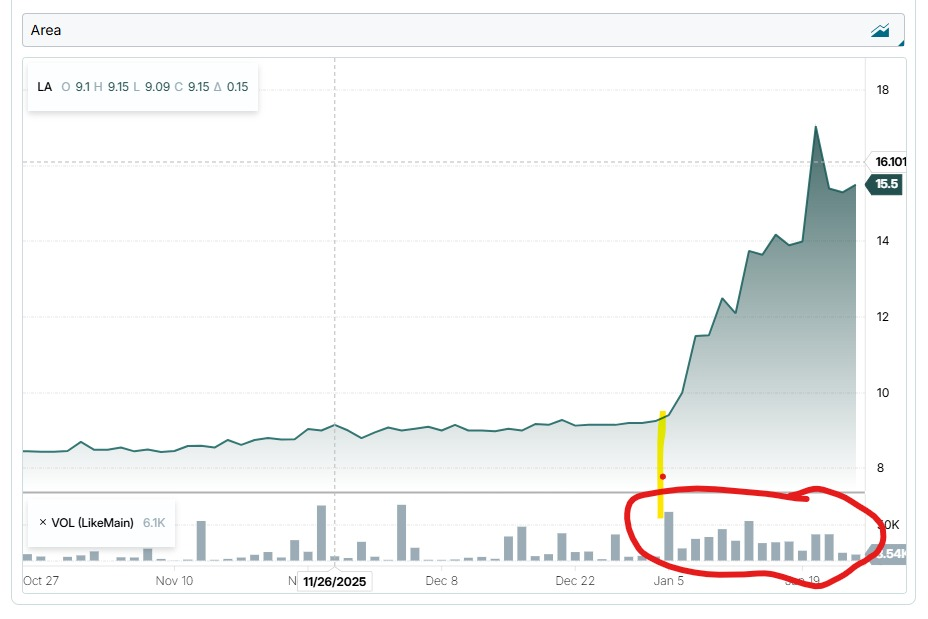
For me, the more interesting issue is simpler: the stock appears to have moved before the story became official.
A quick bit of context
Los Andes Copper is a TSX-V issuer developing the Vizcachitas copper-molybdenum project in central Chile, the kind of asset whose value is shaped as much by permitting /regulatory credibility as by geology.
Chile is also entering a political transition. President-elect José Antonio Kast announced his incoming cabinet ahead of his March 11, 2026 inauguration.
The timeline that matters
Here’s what I got from public sources:
Early January (around Jan. 2): LA begins a sustained, unusual rise after a relatively stable 2025.
Jan. 20 (daytime): Los Andes publishes a release stating CEO Santiago Montt “has been appointed” Minister of Mines for the incoming Kast government and has resigned as CEO, with an interim CEO and transition timeline.
Jan. 20 (evening): the cabinet is presented publicly in Santiago (the ex-CEO of Andes was not included in the announcement).
Jan. 21 (reported): Reuters reports a late shift: Daniel Mas is appointed to oversee both Mining and Economy/Development, and Montt—previously expected for Mining—does not get the role after the premature company announcement.
So yes: there were only hours between the company’s statement and the official cabinet moment.
But hours don’t explain a move that appears to start weeks earlier.
Disclosure vs. certainty
A CEO resignation is the kind of governance event you disclose promptly.
The sharper issue is the level of certainty. The release didn’t say “expected” or “subject to confirmation.” It stated the appointment as a fact.
And Reuters describes a political reaction strong enough to change the outcome.
That’s the communications debate.
It’s also the easy debate.
The harder question is what happened before Jan. 20
If the market repriced $LA.V starting in early January, then the information environment matters more than the wording of a press release.
Because this pattern implies that a “minister premium” may have been building in the stock ahead of official confirmation, and then unwound when the appointment didn’t happen.
That leaves a short list of plausible explanations:
Cabinet information circulated early through informal networks and became tradable expectation.
Some market participants traded on non-public information.
There was another driver of the January repricing that hasn’t been clearly tied to public disclosures.
I’m not asserting wrongdoing. I’m saying the sequence is uncomfortable, and it deserves sharper scrutiny than “they spoke too early.”
The questions I’d actually like to see debated
Who began accumulating $LA.V in early January, and what story were they trading?
Where did the Montt-to-Mining narrative originate, political circles, advisors, industry networks, media?
If abnormal price action appears ahead of a politically sensitive event, what is the right corporate response, tighter language, earlier clarification, a halt, something else?
Will anyone review the pre-announcement trading pattern now that Reuters has explicitly linked the premature release to a cabinet reversal?
Chile is about to test a new governing style in mining, speed, credibility, institutional discipline. Episodes like this matter because they shape trust on both sides: the market’s trust in governance, and the public’s trust in how mining influence is exercised.
If the real leak happened earlier, the Jan. 20 release wasn’t the start of the problem.
It was the moment the problem became visible.
Personal commentary for discussion only. Not investment advice.