


VANCOUVER, BC / ACCESS Newswire / September 29, 2026 / Kalo Gold Corp. (TSXV:KALO)(OTCID:KLGDF)(FSE:9M51) ("Kalo," "Kalo Gold" or the "Company") is pleased to report the identification of fine-grained electrum, a naturally occurring gold-silver alloy, in 2026 drill core from Wainikoro at the Company's 100%-owned Vatu Aurum Project in Fiji.
The electrum was identified during an MSc research project completed by Heidi Walton at the Camborne School of Mines, University of Exeter, supported by the Company. The study integrated geological mapping, trench observations, drill core logging, geochemistry, X-ray diffraction ("XRD"), optical microscopy and scanning electron microscopy with energy-dispersive X-ray spectroscopy ("SEM-EDS").
Highlights
- SEM-EDS analysis identified a discrete electrum grain measuring approximately 20 micrometres in drill hole VA26-DH19.
- The grain returned an approximate composition of 68.6 weight percent ("wt.%") gold and 31.4 wt.% silver.
- Electrum occurs directly against the margin of arsenian pyrite within a sericite-bearing matrix.
- The host sample, collected from 189.88 to 191.00 metres downhole, comprises chlorite-altered polymictic volcanic breccia cut by quartz-carbonate veinlets and containing disseminated sulphides.
- The observation provides direct mineralogical evidence that gold at Wainikoro occurs locally as a fine-grained gold-silver alloy.
- The study supports a structurally controlled hydrothermal model in which repeated fracturing, brecciation and vein reopening provided pathways for mineralizing fluids through permeable volcanic rocks.
- Prospectivity modelling identified priority areas where elevated gold and arsenic responses coincide with interpreted structures.
CEO Commentary
"The identification of electrum is an important addition to our understanding of Wainikoro," said Terry Tucker, President and CEO of Kalo Gold. "We now have direct mineralogical evidence of a gold-silver phase within the hydrothermal system, together with a clearer understanding of its relationship to alteration and brecciated host rocks. This work gives our exploration team practical criteria for refining future trench and drill targets."
Direct Identification of Gold-Silver Mineralization
The electrum-bearing sample was collected from drill hole VA26-DH19 at a downhole depth of 189.88 to 191.00 metres. It consists of polymictic volcanic breccia containing altered rock fragments surrounded by quartz-carbonate material and cut by a network of veinlets.
SEM-EDS examination of sample HW-SEM-05 identified an approximately 20-micrometre electrum grain at the margin of an arsenian pyrite grain within a sericite-bearing matrix (Figure 1). Its approximate composition was measured as 68.6 wt.% gold and 31.4 wt.% silver.
The electrum-bearing sample also contains chlorite, quartz, manganese-bearing calcite, titanomagnetite and fluorapatite. These minerals occur within an altered and repeatedly fractured breccia, with clast boundaries, fractures and vein margins providing potential interconnected pathways for hydrothermal fluids.
Twelve polished thin sections, each prepared from a 48 mm × 25 mm billet, were examined during the study: eight from drill core between 33.72 and 191.00 metres downhole, and four from surface rock samples collected at and adjacent to trench TR009. Only one discrete electrum grain was identified, in sample HW-SEM-05; arsenian pyrite, sphalerite and sericite were identified in multiple sections. Given the grain's small size and the limited volume of material examined in polished section, other fine-grained gold-bearing phases could remain undetected. Additional mineralogical and gold-deportment studies will be required to determine the relative abundance and distribution of electrum, native gold and any submicroscopic gold associated with sulphides.
Evidence for Repeated Hydrothermal Activity
SEM-EDS analysis of additional VA26-DH19 samples identified pyrite, arsenian pyrite, sphalerite, chalcopyrite and pyrrhotite associated with quartz-carbonate veining, sericite, chlorite and locally brecciated volcanic rocks.
The observed textures record multiple episodes of brittle fracturing, vein formation, reopening and sulphide deposition. Gold enrichment in VA26-DH19 appears to be preferentially associated with brecciated, sulphide-bearing and repeatedly veined intervals, rather than with alteration intensity or depth alone.
The principal assayed gold interval in the hole returned 1.61 grams per tonne ("g/t") gold over 1.50 metres at approximately 150 metres downhole (previously disclosed in the Company's news release dated 30 June 2026). Material near this interval contains crackle brecciation, quartz-rich fracture infill, pyrite, arsenian pyrite and sphalerite. Together with the electrum identified deeper in the hole, these observations support a mineralized hydrothermal system extending through multiple structurally prepared intervals.
Multivariate analysis of the drill core geochemistry identified a broader gold-silver-arsenic-antimony-lead-molybdenum hydrothermal association. Gold showed its strongest statistical relationships with lead, silver and molybdenum, while arsenic and antimony formed a more extensive pathfinder signature.
Implications for Exploration
The study integrates the mineralogical results with surface mapping and regional geophysical interpretation to refine the structural model for Wainikoro. Surface mapping around trench TR009 and drill hole VA26-DH19 recorded quartz and quartz-carbonate veins in northeast- and north-northwest-trending sets. Regional magnetic interpretation identified intersecting structural trends that may have created zones of enhanced permeability.
Arsenic soil anomalism broadly overlaps known surface gold responses and interpreted structural corridors. The repeated identification of arsenian pyrite in drill core, including its direct association with electrum, supports the continued use of arsenic as an exploration vector. However, arsenic is interpreted as defining a broader hydrothermal footprint and should not be treated as a direct substitute for gold assays.
The prospectivity modelling completed as part of the study ranked areas in which elevated gold and arsenic responses coincide with interpreted structures, providing additional criteria for prioritizing follow-up trenching and drill targeting.
The results of the dissertation represent an interpretation of the datasets examined and do not establish the continuity, grade or economic significance of mineralization at Wainikoro. Further trenching, drilling, assaying and mineralogical studies are required.
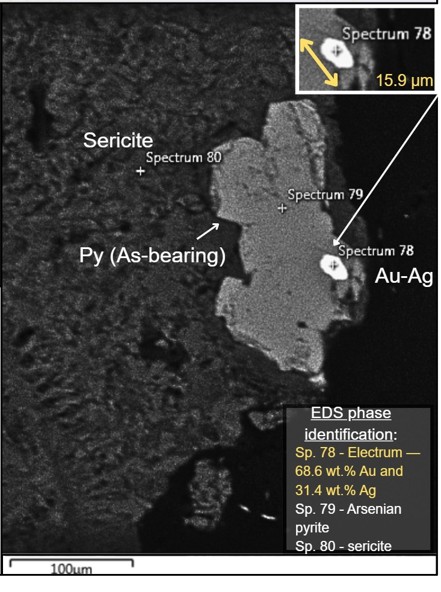
Figure 1. SEM electron image of sample HW-SEM-05 (VA26-DH19, 189.88-191.00 m) showing an electrum (Au-Ag) grain at the margin of arsenian pyrite within a sericite-bearing matrix. The electrum appears bright white and is approximately 20 µm across, as shown in the enlarged inset. EDS analysis at Spectrum 78 returned 68.6 wt.% Au and 31.4 wt.% Ag; the larger, irregular grey grain was identified as arsenian pyrite (Spectrum 79) and the adjacent matrix as sericite (Spectrum 80). Crosses mark EDS analysis locations. Scale bar = 100 µm. Image: H. Walton, Camborne School of Mines, University of Exeter.
Drill Collar Location
Hole ID | Easting | Northing | Azimuth (°) | Dip (°) | Total Depth (m) |
VA26-DH19 | 775037 | 8192052 | 145 | 55 | 270.6 |
Coordinates are reported in UTM Zone 60 South (WGS84 datum). Collar data for VA26-DH19 were previously disclosed in the Company's news release dated 30 June 2026.
Qualified Person
The technical information in this news release was prepared, reviewed, and approved by Andrew Randell, P.Geo., CEO and Principal Geoscientist of SGDS-Hive, Technical Director of the Vatu Aurum Project, and a Qualified Person as defined by NI 43-101. Mr. Randell is independent of the Company and has verified the data disclosed, having conducted multiple site visits (2023-2026) and direct supervision of the exploration program.
The research project described in this news release was carried out with the Company's support and under Mr. Randell's supervision as Qualified Person. Mr. Randell has reviewed the mineralogical results reported above and is responsible for their disclosure in this news release.
Quality Assurance / Quality Control
No new assay results are reported in this news release. The gold assay referred to above for VA26-DH19 - 1.61 g/t gold over 1.50 metres from 150.00 to 151.50 metres downhole - was previously disclosed in the Company's news release dated 30 June 2026 and was determined by ALS Limited (Australia) using method Au-AA25 (30 g Fire Assay, AAS Finish). ALS is accredited by NATA to ISO/IEC 17025 and is independent of the Company and the Qualified Person.
The mineralogical results reported in this news release were generated by optical microscopy, X-ray diffraction and scanning electron microscopy with energy-dispersive X-ray spectroscopy carried out at the Camborne School of Mines, University of Exeter, using a TESCAN VEGA3 scanning electron microscope with energy-dispersive X-ray spectroscopy and a Bruker D6 Phaser X-ray diffractometer, in accordance with the School's standard operating procedures. Energy-dispersive analysis has a detection limit of typically around 0.5% for the elements analysed, and XRD of powdered samples has detection limits of approximately 1% to 5%. These are mineralogical characterization techniques and are not commercial assay methods. The electrum composition reported - approximately 68.6 wt.% gold and 31.4 wt.% silver - is an approximate energy-dispersive estimate for a single grain and is not representative of the gold-silver ratio of mineralization at Wainikoro. No mineral resource or mineral reserve has been estimated on the Vatu Aurum Project.
About Kalo Gold Corp.
Kalo Gold Corp. is a gold exploration company advancing the 100%-owned Vatu Aurum Project (Special Prospecting Licences 1511 and 1464), a 367 km² land package on Vanua Levu, Fiji, located in a preserved volcanic back-arc setting. The Company's work is focused on a northeast-trending corridor of low-sulphidation epithermal gold targets. Exploration across the corridor - including at the flagship Aurum Prime area and Wainikoro - has defined multiple structurally controlled gold targets supported by drilling, trenching, soil geochemistry, structural mapping and airborne geophysics. The Company is systematically advancing priority exploration targets toward potential discovery.
Kalo Gold Corp. is headquartered in Vancouver, British Columbia, and is listed on the TSX Venture Exchange (KALO), the OTCID Market (KLGDF), and the Frankfurt Stock Exchange (9M51).
On behalf of the Board of Directors of Kalo Gold Corp.
Terry L. Tucker, P.Geo.
President and Chief Executive Officer
Kevin Ma, CPA, CA
Executive Vice President, Capital Markets and Director
For further information: info@kalogoldcorp.com | www.kalogoldcorp.com
Neither the TSX Venture Exchange nor its Regulation Services Provider (as that term is defined in the policies of the Exchange) accepts responsibility for the adequacy or accuracy of this press release.
Cautionary Statement Regarding Forward-Looking Information
This news release contains "forward-looking statements" and "forward-looking information" within the meaning of applicable Canadian securities laws (collectively, "forward-looking statements"). All statements other than statements of historical fact are forward-looking statements. Forward-looking statements can often, but not always, be identified by the use of words such as "will", "may", "should", "could", "would", "anticipate", "believe", "estimate", "expect", "intend", "interpret", "plan", "potential", "continue", "target", "prospective", "scheduled", "conceptual", and similar expressions, or by statements that certain actions, events or results "may", "could" or "will" be taken, occur or be achieved.
Forward-looking statements in this news release include, but are not limited to: (i) the interpretation that the electrum grain identified in VA26-DH19 reflects a gold-silver phase occurring more widely within the Wainikoro hydrothermal system; (ii) the interpretation that gold at Wainikoro occurs locally as a fine-grained gold-silver alloy associated with arsenic-bearing sulphides and hydrothermal alteration; (iii) the interpretation that repeated fracturing, brecciation and vein reopening provided pathways for mineralizing fluids through permeable volcanic rocks, and that clast boundaries, fractures and vein margins provided potential interconnected pathways for hydrothermal fluids; (iv) the interpretation that gold enrichment in VA26-DH19 appears to be preferentially associated with brecciated, sulphide-bearing and repeatedly veined intervals rather than with alteration intensity or depth alone; (v) the interpretation of a gold-silver-arsenic-antimony-lead-molybdenum hydrothermal association and the continued use of arsenic as an exploration vector; (vi) the interpretation that intersecting structural trends identified from regional magnetic data may have created zones of enhanced permeability; (vii) the expectation that priority areas identified by prospectivity modelling will assist in prioritizing follow-up trenching and drill targeting; (viii) the expectation that additional mineralogical and gold-deportment studies, trenching, drilling and assaying will be undertaken and will produce useful results; and (ix) the Company's ability to secure the financing, permits, tenure and regulatory approvals required to advance exploration on the Vatu Aurum Project.
Forward-looking statements are based on a number of assumptions that the Company considers reasonable but which may prove to be inaccurate, including: that the Company will be able to fund and execute the planned exploration programs; that the mineralogical, geochemical and analytical data generated by the research project described in this news release are accurate and have been correctly interpreted; that the samples and polished sections examined are representative of the material from which they were taken; that permits, tenure, and licences will remain in good standing; that there will be no adverse change in the political, regulatory, or operational environment in Fiji, including potential fuel shortages; and that commodity prices and capital markets conditions will support continued exploration.
Forward-looking statements are subject to known and unknown risks and uncertainties that may cause actual results to differ materially from those expressed or implied, including: exploration risk generally, and the risk that exploration does not result in a discovery - no mineral resource or mineral reserve has been estimated on the Vatu Aurum Project, and the targets described in this news release are conceptual in nature; the risk that a single electrum grain identified within one polished section is not representative of the distribution, abundance, grade or continuity of gold mineralization at Wainikoro, and that the observation may not be reproduced by further work; the risk that scanning electron microscopy with energy-dispersive X-ray spectroscopy provides approximate compositional estimates that may differ from values determined by quantitative analytical methods; the risk that the conclusions of a research project may differ from those reached by the Company or its Qualified Person on further review; the risk that geological, geochemical, mineralogical and structural interpretations may change materially as additional data become available; the risk that arsenic soil anomalism does not reliably vector to gold mineralization; permit, tenure, and title risk; risks of operating in Fiji, including fuel supply, logistics, and currency risk; dependence on key personnel; environmental, health, and safety risk; financing and dilution risk; and commodity price volatility.
Forward-looking statements are not guarantees of future performance, and readers are cautioned not to place undue reliance on them. The forward-looking statements in this news release are made as of the date of this news release. The Company does not undertake any obligation to update or revise any forward-looking statements, whether because of new information, future events, or otherwise, except as required by applicable securities laws. Readers are directed to the Company's continuous disclosure filings available on SEDAR+ at www.sedarplus.ca.
SOURCE: Kalo Gold Corp.
View the original press release on ACCESS Newswire