
President Trump said Sunday that American officials will travel to Pakistan for another round of negotiations aimed at ending the war with Iran, as a two-week cease-fire is set to expire this week.
Vice President JD Vance is expected to lead the talks. However, significant gaps remain between the two sides, particularly as the U.S. continues to press Iran to lock up its nuclear program and reopen the Strait of Hormuz. Iran has signaled it may not attend talks, saying Washington’s demands are excessive.
Against this backdrop, tensions in the region have continued to escalate. Iran announced it is closing the Strait of Hormuz again to commercial vessels, warning that any ship approaching the area could be targeted. Tehran has already effectively blocked the waterway for nearly two months, sending global energy prices sharply higher. On Friday, Trump said a naval blockade of Iranian ports would remain in place until a peace agreement is reached.
As a result, reduced shipping activity across the Gulf has amplified the “war trade,” a market pattern where energy prices rise, the U.S. dollar strengthens, and equities come under pressure.
Energy traders reacted quickly, pricing in renewed disruption risk around the Strait of Hormuz. Because the waterway carries a major share of global oil shipments, any restriction there tends to ripple through inflation expectations. Higher oil prices can drive up transport costs, which eventually feed into higher consumer prices.
Financial markets have already begun to reflect this shift in sentiment. Dow Jones futures dropped about 400 points, or 0.7%. The S&P 500 futures slipped 0.6%, while Nasdaq futures declined 0.5%, pulling back after both indexes reached record highs last week.
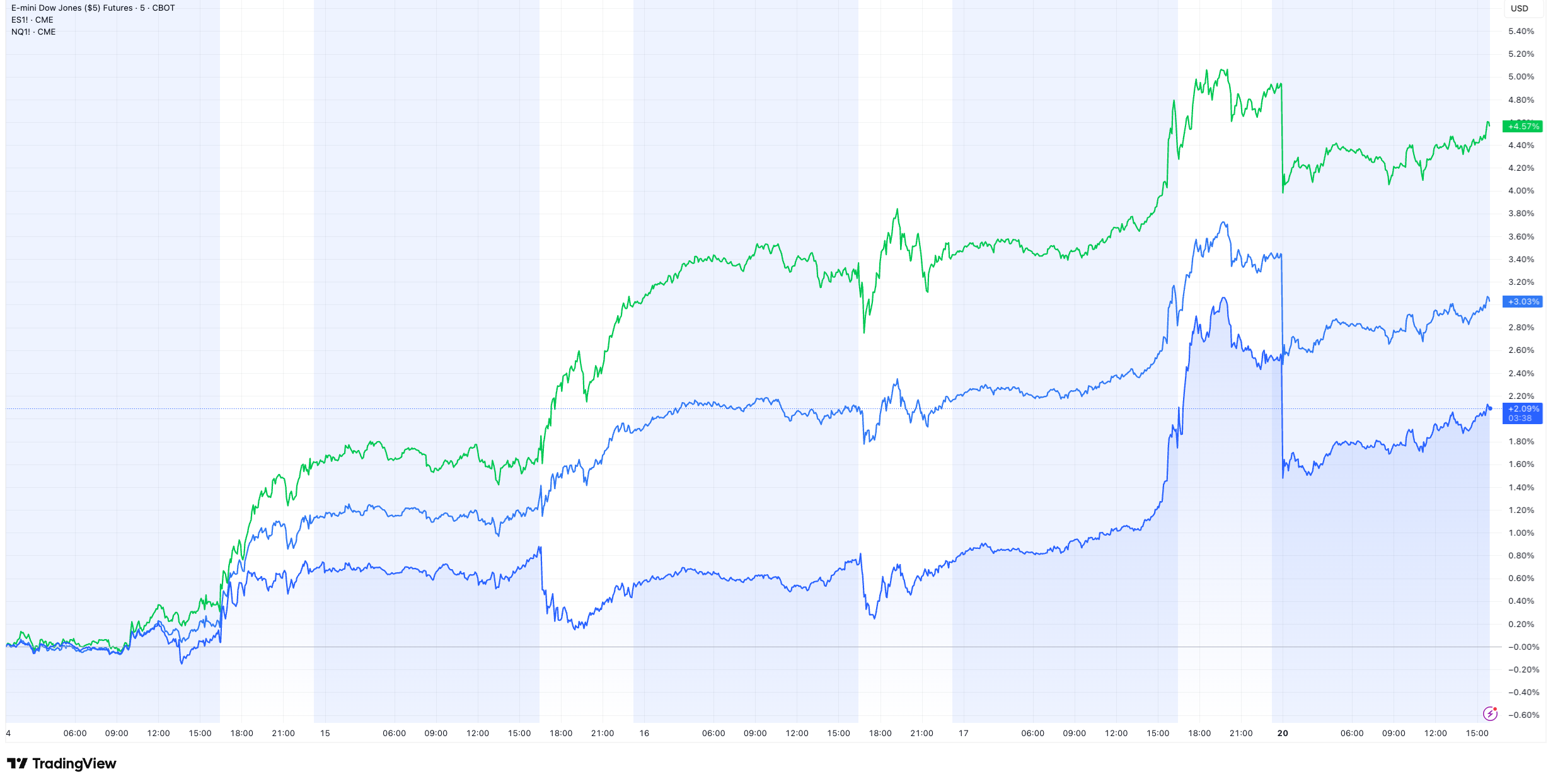
Notably, the Nasdaq had just completed a 13-session winning streak — its longest since 1992 — underscoring how quickly market sentiment can swing from optimism to caution when geopolitical risks resurface.
Meanwhile, gold price decreased 2% early Monday, sliding to around $4,730 before stabilizing closer to $4,800. Although gold is typically seen as a safe haven during geopolitical stress, this time a stronger U.S. dollar and rising bond yields outweighed that demand.
Taken together, the situation reflects a familiar “here we go again” moment for markets — stuck between hope for diplomacy and the risk of renewed escalation. Trump also warned the U.S. could target Iranian infrastructure if no agreement is reached, rhetoric that typically drives volatility higher even before the opening bell.