

How many times a day do you hear the term “AI”? Five, ten, twenty… And how often do you actually use it — daily, weekly, monthly? Artificial intelligence has become an integral part of our daily life, influencing everything from politics and the arts to work and commerce. While many express openness to AI’s potential benefits, concerns persist about its impact on human skills, job security, and certain industries.
Companies across most sectors are investing heavily in artificial intelligence: 88% of organizations report regular AI use. Yet many leaders face familiar frustrations. Adoption stalls, performance gains plateau.
The reasons behind these challenges are varied. Employees fear job displacement or a reduction in their value as workers. Others feel a loss of human connection with colleagues or worry that AI could diminish their ability to think creatively — or even think independently.
Technology and financial services sit at the center of this tension. These industries have experienced repeated waves of disruption, restructuring, and skill obsolescence. Conswquently, AI is viewed both as a growth driver and a career threat.
Even employees who recognize AI’s business value may worry about its power, scalability, and competitive implications — and what these mean for their own security and relevance.
On the other hand, artificial intelligence promises higher productivity, faster workflows and fatter margins. Yet, entire software, legal, financial and logistics segments could see pricing power erode. Investors have recently sold off software, wealth management and even trucking stocks — not because AI doesn’t work, but because it might work so well that it commoditizes services and compresses fees.
Capital expenditure also remains a pressure point. Hyper-scalers are investing hundreds of billions in data centers and chips. If the returns on these investments lag expectations, earnings multiples could require recalibration.
In short, AI is a double-edged sword. It can drive significant productivity gains, but it also has the potential to disrupt entire industries.
Recent market activity reflects this uncertainty. S&P 500 futures dropped 0.5% to 0.6%. Nasdaq contracts fell nearly 1%, while Dow futures eased 0.3%.
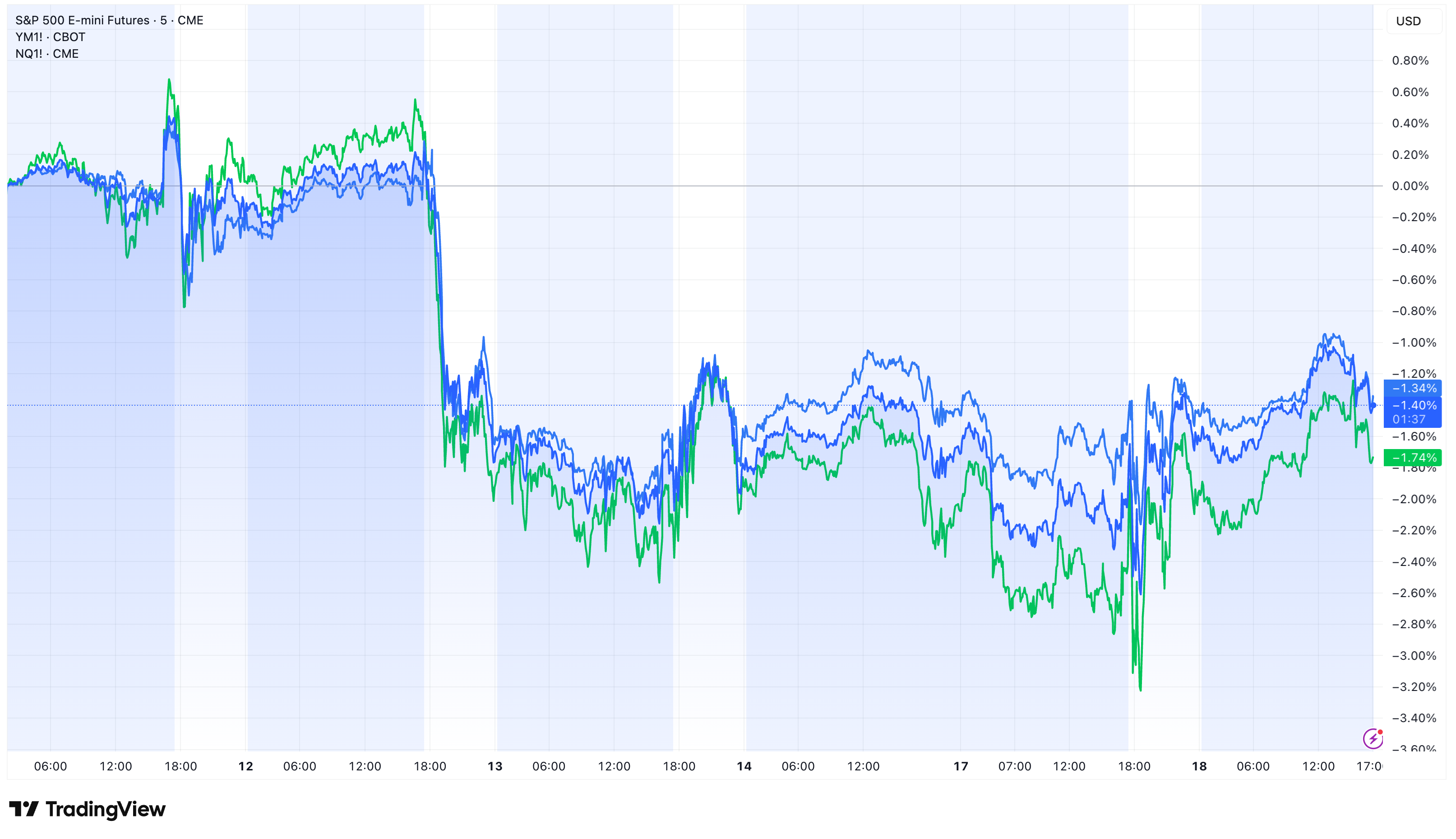
Market conditions amplified these moves. With U.S. exchanges closed for Presidents Day on Monday, trading volumes were thin, making even moderate selling appear more dramatic. Both the S&P 500 and Nasdaq are now in negative territory for the year.
Enthusiasm is cooling as some of AI’s side effects come into focus. What was once an AI-fueled rally is evolving into a debate over who will benefit — and who risks being automated out of relevance.
Regardless of whether you feel optimistic or pessimistic about AI, one thing is clear: as it becomes embedded into every aspect of work and life, the rational approach is to engage with it enough to understand it.