

Electrical platinum demand rose 22% year over year to 29,000 ounces in the second quarter of 2026, as AI hardware draws on the metal for data storage, chipmaking coatings, and glass-fiber production. Automotive demand is still forecast to fall 4% for the full year, and a projected 2026 market surplus shows industrial growth has not yet tightened supply.
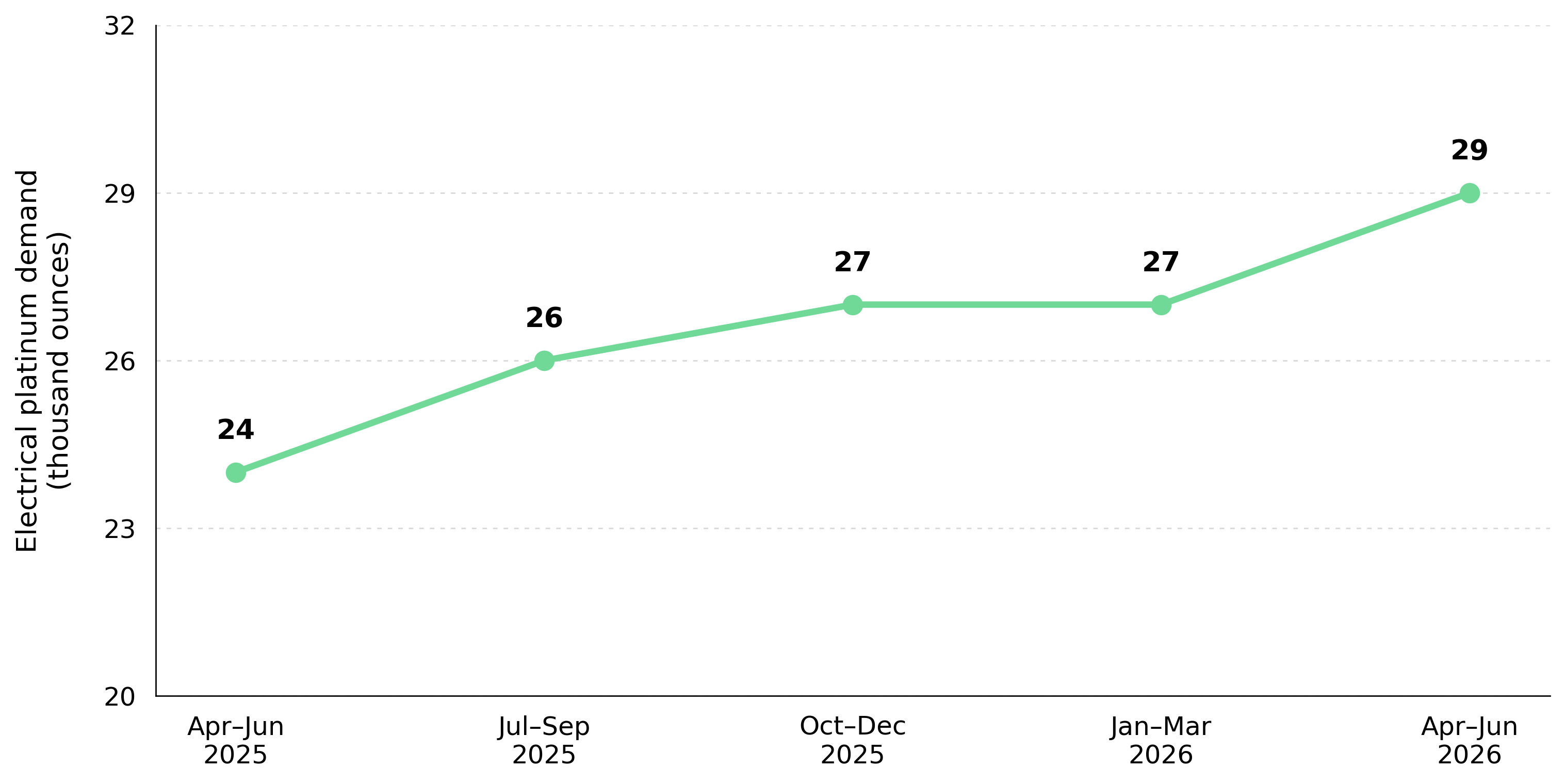
Electrical Platinum Demand Grows 22% as Vehicle Catalyst Use Declines
The World Platinum Investment Council (WPIC), using independent analysis by Metals Focus, forecasts industrial platinum demand rising 5% to 2.385 million ounces in 2026, while automotive demand falls 4% to 2.904 million ounces. The Semiconductor Industry Association reported August global chip sales of $159.7 billion, up 144.3% year over year. Sales reflect prices and product mix as well as volumes, so revenue growth cannot be converted directly into platinum consumption.
Data Storage Ties Platinum Use to Hard Drive Output, Not Capacity
Hard disk drives (HDDs) use platinum and ruthenium in magnetic recording layers. Heat-assisted magnetic recording relies on iron-platinum thin films to keep data stable at higher storage densities. Added storage can also come from solid-state drives, so platinum use tracks HDD production and metal per drive rather than total storage growth.
Chipmaking Coatings and Glass-Fiber Equipment Add Platinum Demand Outside Vehicles
Selected chipmaking and sensor processes use sputtering to deposit thin platinum coatings with specific electrical properties. Platinum-rhodium equipment draws molten glass into fibers for electrical-grade fabrics, which form the base of printed circuit boards in AI hardware. Metal purchases depend on glass-fiber capacity additions and equipment replacement, and reported glass-sector consumption also includes non-AI uses.
Equipment Spending Lifts Platinum Demand Only When New Production Lines Run
SEMI reported second-quarter 2026 equipment billings of $40.53 billion, up 23% year over year, and forecasts full-year equipment sales of $165.9 billion. Silicon wafer shipments rose 7.4% to 3,573 million square inches. Neither measure quantifies platinum use; installation and production schedules decide when spending becomes metal demand.
Broader Industrial Demand Raises the Value of Defined Platinum Supply Projects
ValOre Metals ($VO) targets a Preliminary Economic Assessment for its Pedra Branca project in Brazil in Q4 2026, building on a March 2022 inferred resource of 2.198 million combined platinum, palladium and gold ounces. Processing tests and water and power studies run alongside.
Nick Smart, Chief Executive Officer of ValOre Metals, links tight supply to price pressure:
"We see significant headwinds in terms of supply constraints around supply, and we're starting to see that play through, in terms of that balance: ongoing demand, constrained supply creating pressure on prices."
Investment Selling Can Hold Platinum Prices Down Despite Rising Industrial Use
WPIC puts 2026 electrical demand at 118,000 ounces, about 1.7% of total demand of 7.089 million ounces, and projects a 265,000-ounce surplus with net investment outflows of 83,000 ounces. AI consumption sits within existing industrial categories rather than a standalone estimate. Investment selling can release metal while manufacturers keep buying, so project valuations hold up best when tested against lower prices, higher capital costs and weaker recoveries.
Where Platinum Mining Value Rests On
AI hardware gives platinum a growing industrial outlet, while a 2026 surplus and investment outflows still limit price support. Reported electrical consumption, rather than chip revenue, is the reliable demand signal. Producer margins rest on operating costs and metal prices. Developer and explorer value re-rates as studies prove recoverable metal, construction costs, and power, water and permitting access, with initial assessments due before year-end.
Read more: AI Hardware Supports Platinum Demand Beyond Cars
Disclosure: This article features ValOre Metals as a company example. ValOre Metals had no influence over the topic, thesis, or conclusions of this article, and exercised no editorial control over its content.