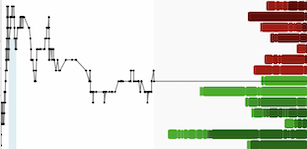


And that’s how more than $1 trillion in market value disappears.
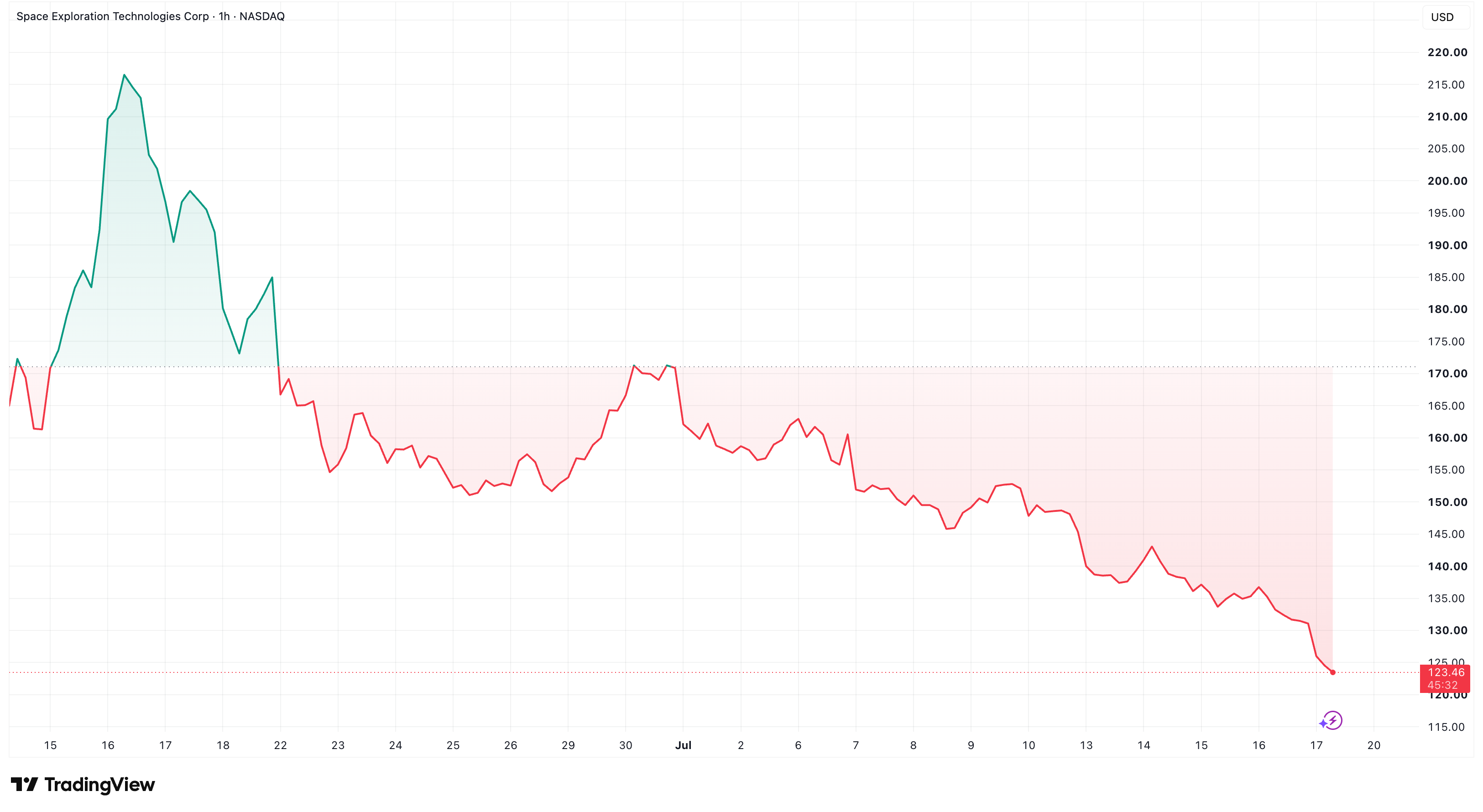
SpaceX stock briefly slipped below its $135 IPO price on Wednesday, touching an intraday low of $132.15 before recovering to close at $135.27. The selling continued on Thursday, with the stock falling another 3% to close at a fresh all-time low of $131, marking its fifth consecutive losing session.
The shares have now declined roughly 40% from their post-IPO peak, erasing more than $1 trillion in market capitalization. That’s a sharp reversal from mid-June, when the stock surged to $225, lifting the company’s valuation above $3 trillion, making SpaceX more valuable than Amazon.
Several factors appear to be weighing on investor sentiment. One is the prospect of additional shares entering the market. As early investors become entitled to sell, the increased supply could outpace demand.
Valuation concerns have also come into focus. While SpaceX remains a fast-growing company, it has yet to turn a profit, prompting investors to question how much future success is already reflected in the current share price.
This week attention shifted to what many hoped would be the next positive catalyst: SpaceX's 13th Starship test flight.
However, the company postponed the launch of its flagship Starship rocket. The mission was expected to be SpaceX’s first launch since going public, and the delay didn’t reassure investors. Shares fell as low as $124 during the session.
The stakes are high because Starship is the driver of SpaceX’s long-term growth story. The fully reusable launch system is designed to reduce launch costs while significantly increasing the amount of cargo the company can deliver to orbit.
The mission itself was ambitious, featuring full booster launch, stage separation, a landing attempt, deployment of 20 next-generation Starlink V3 satellites, and a restart of one of the upper stage's Raptor engines in space before a planned splashdown in the Indian Ocean.
The launch delay adds to mounting pressure on the stock, which has fallen from its post-IPO highs as investors question whether expectations have gotten ahead of reality.
It's also not the first setback. Starship's 12th test flight was postponed before eventually launching in May. Investors know that space development takes time. The stock market, however, judges every delay in real time.
Every successful test gives investors more confidence in the project. Every delay raises more questions.