

An hour before the deadline was set to expire, President Donald Trump posted on Truth Social that the U.S. and Iran were "very far along" with a "definitive" peace agreement and had agreed to a two-week ceasefire to allow negotiations to proceed.
In the wake of that announcement, both sides are now set to engage in talks over the next two weeks, buying some time to try to reach a permanent settlement. Israel also confirmed its agreement to the ceasefire.
Iran's Supreme National Security Council confirmed it had agreed to reopen the Strait of Hormuz for two weeks, contingent on a full halt to attacks, with transit to be coordinated through Iran's Armed Forces.
The agreement effectively allowed Trump to avoid a difficult choice — either escalating the conflict with his warning that a "whole civilisation will die tonight," or backing down and potentially undermining his credibility.
For the first time since the conflict began five weeks ago, all three parties are publicly aligned on a pause, and market reactions quickly followed.
Currencies moved sharply on the news. The euro, pound, Japanese yen all surged after reports of a two-week pause in hostilities and efforts to reopen the Strait of Hormuz. Meanwhile, the U.S. dollar index dropped sharply toward 98.80.
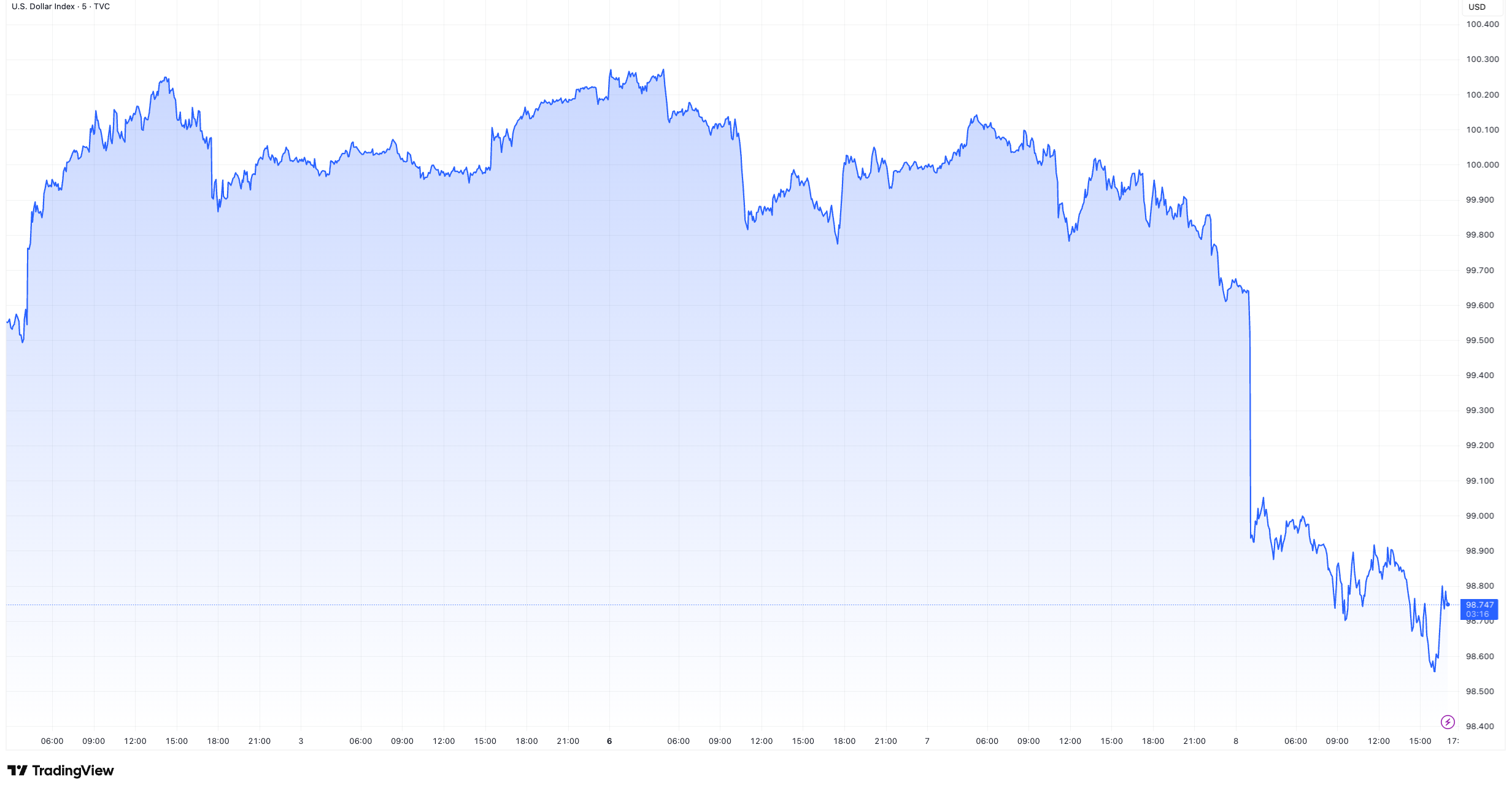
During the escalation phase, traders had flocked to the dollar for stability and liquidity. However, with tensions easing, those flows reversed quickly across major currency pairs.
Commodities also reacted. U.S. crude futures fell more than 15% following the ceasefire announcement, removing one of the key inflation risks that had supported the dollar during the conflict’s peak.
As energy prices decline, the probability of interest rate cuts increases due to easing inflationary pressure. Lower expected rates weaken the dollar’s yield advantage.
Precious metals responded as well. Gold (XAUUSD) surged to around $4,850 on Wednesday morning, breaking out of a descending channel that had capped prices since early March.
More broadly, the news of a temporary safe-passage window through the Strait of Hormuz helped calm energy markets and stabilize global risk sentiment.
For asset classes that have been trading on a war premium for the past five weeks, the ceasefire represents a broad unwind trigger. Equities also benefited, as airlines, industrials, and consumer stocks — previously pressured by rising energy costs — found relief.
At the same time, expectations for interest rate cuts, which had collapsed from around a 96% probability to near zero during the escalation, are beginning to recover as the inflation outlook improves.
Looking ahead, markets will be focused on three key developments over the next fourteen days: whether tanker traffic through the Strait of Hormuz normalizes toward pre-conflict levels, whether the negotiations produce a durable agreement, and whether oil prices continue to retreat toward the $65–$70 range.