

Between 2022 and 2025, the global base of active luxury consumers slipped from 400+ million down to about 340 million, as shown in the Bain & Company Altagamma Luxury Goods Worldwide Market Study.
In parallel, the share of potential buyers who actually made a purchase fell sharply, from roughly 60% to something between 40% and 45%, and the pace of new customer acquisition also decreased by 5% year on year.
French estimates run higher. Les Echos Etudes puts the loss at 50 to 60 million clients in 2023 and 2024 alone, and 70 to 80 million over three years. Eric Briones, CEO of Journal du Luxe and co-author of Luxe Renaissance, uses the most aggressive framing: 70 million clients lost in two years, with the sector's pricing power falling below 10%, down from 35% twelve years ago.
The proximate cause is well documented. RBC analysts estimated that major luxury groups raised prices by an average of 33% between 2019 and 2024, and that these increases accounted for roughly half of the sector's organic sales growth over the preceding two years. Growth, in other words, came substantially from higher prices rather than customer acquisition.
We can observe the same trend in individual product lines. Chanel's Classic Flap Medium, which was priced at around €5,350 in 2019, reached approximately €11,000 by 2026. Even the "starter" segments weren't spared: Miss Dior climbed 29% from 2019 to 2025, while Chanel No. 5 jumped by 32%.
The error was not the increase itself. It was raising prices without raising scarcity. Bain's Federica Levato reported that more than half of luxury customers now consider luxury brands overpriced, and that net promoter scores have fallen below pre-COVID levels, the sharpest such drop on record.
The volume side moved in the opposite direction from the exclusivity narrative. Briones argues the sector mistook the post-COVID demand surge (boosted by US stimulus) for a permanent state, and responded by producing more, charging more, and saturating public space.
This produced a double defection. Affluent buyers were pushed out by price; genuinely wealthy buyers withdrew because a brand that is visible everywhere no longer signals anything.
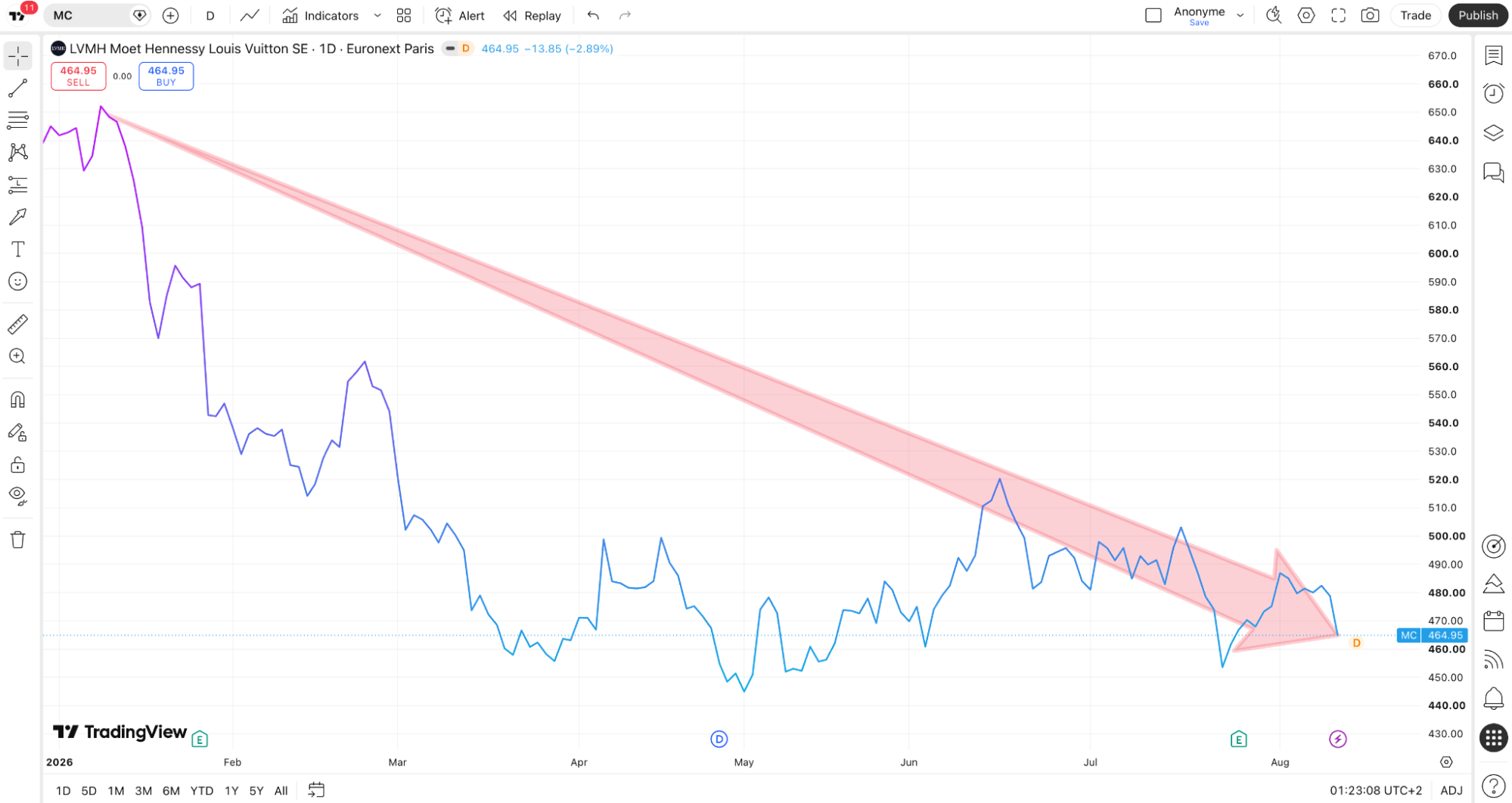
Briones describes, on one side, clients who felt poor and, on the other, wealthy clients who questioned an exclusivity they had assumed was permanent. The pressure on the sector is also reflected in LVMH's share-price decline.
Customers did not stop spending. Bain describes a "tectonic shift" in which luxury experiences are attracting more spending (think hospitality, cruises, fine dining) while personal luxury goods are losing ground. The secondhand market hit roughly €50 billion in 2025, and has been growing faster than the primary market, which says a great deal about where demand is heading.
The path out is narrow. Aspirational and occasional clients represent 95% of luxury customers and 61% of market value. They cannot be abandoned without breaking the model; but they cannot be recovered by cutting prices either, since that would destroy the perceived value of every prior purchase.
The financial consequence is already visible. EBIT margins for selected personal luxury brands, which peaked at 23% in 2012, are expected to reach 15 to 16% in 2025, roughly where they stood in 2009. Bain attributes an estimated €100 billion loss (over $115 billion at the current EUR USD exchange rate) in the industry's enterprise value to that contraction.
The lesson generalises beyond handbags: optimising a measurable proxy for desire can end up destroying the appeal it was meant to capture, precisely when the metric peaks.