
Disclaimer: This article reflects my own analysis, interpretation, and best‑effort reasoning based on publicly available information, peer comparisons, and observed financing patterns. It is speculative in nature and should not be taken as fact, guidance, or financial advice. Ocean Partners’ decisions, AW1’s internal processes, and Storm’s final PFS outcomes may differ from my expectations. Please conduct your own due diligence and consult qualified advisors before making investment decisions.
=================================================================
While we sit here twisting our thumbs, refreshing the AW1 news release page and muttering “PFS today please,” maybe the healthier move is to stop staring at the finish line… and start looking at the power plays at the table.
Because when a PFS is delayed once, it’s annoying. When it’s delayed twice, it’s concerning. When it’s delayed five times, something structural is happening. Who has the power to grind a Storm‑level project and say, “Hey, you know what — let’s keep optimizing”?
Before we answer that, let’s pause and get to know the most important financier at this stage of Storm’s life — Ocean Partners.
But first, we need to settle the only question that actually matters - Will Storm proceed?
Storm Will Proceed — Because Storm Is That Good
Storm’s economics force approval.
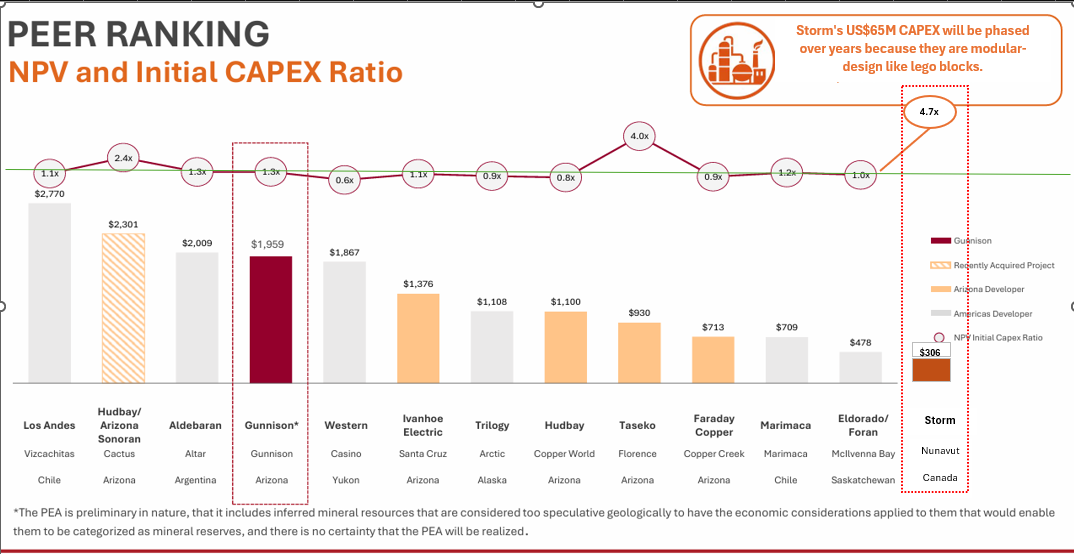
Storm sits at the top of the global copper development curve — a rare high‑efficiency project with a 4.7× NPV/CAPEX ratio, outperforming billion‑dollar peers across the Americas. High‑efficiency projects don’t get rejected; they get refined. The only real question is how perfect OP wants the PFS before financing.
Once you understand how OP works, the delays stop looking mysterious. They start looking predictable.
📊 Storm’s NPV/CAPEX Ratio (Peer Comparison)
Base slide sourced from GCU’s corporate presentation; Storm added for comparison. All values in US Dollars
🥇 Competitive Analysis: Storm’s Efficiency Advantage
Storm’s NPV/CAPEX ratio is 4.7× — the highest among major copper development projects globally. placing Storm in the elite efficiency tier, above:
Vizcachitas (Chile)
Cactus (Arizona)
Altar (Argentina)
Gunnison (Arizona)
Casino (Yukon)
Santa Cruz (Arizona)
Arctic (Alaska)
Copper World (Arizona)
Florence (Arizona)
Copper Creek (Arizona)
Marimaca (Chile)
McIlvenna Bay (Saskatchewan)
Storm is not a marginal project. Storm is a high‑efficiency copper asset in a world starving for copper. Storm’s excellence answers the question “What if OP does not approve?” They would approve — because Storm’s economics force approval. The only question is how perfect OP wants the PFS before financing.
📈 Peer Ranking Chart — Storm’s Efficiency in Context
Storm’s 4.7× NPV/CAPEX ratio puts it at the very top of the global copper development curve — the hare outrunning every turtle on the chart. Storm sits at the far right:
smallest CAPEX
modular “lego block” design
highest efficiency
fastest payback profile
Storm isn’t just competitive. Storm is dominant.
🧭 The Two Most Relevant Ocean Partners Project‑Finance Deals
To understand Storm’s timeline, we need to understand how OP behaves when they finance real projects — not simple offtake agreements, but true project finance, where OP reshapes the capital stack, influences timing, and demands optimization.
These two deals — Canadian Copper and Silver Bow — are the closest analogues to Storm. They show OP’s fingerprints clearly.
1️⃣ Canadian Copper (Bathurst Complex) — Debt + Offtake + Optional Equity
📅 Timeline
May 2024 — CCI announces financing discussions
July 2024 — OP + OR Royalties term sheet signed
Aug–Oct 2024 — Capital stack finalized
Apr 2026 — Project‑finance package announced
🧱 Deal Structure
Up to C$48M project debt
100% concentrate offtake
Optional equity (up to C$10.5M)
OR Royalties takes Au/Ag stream
🧬 Share‑Structure Impact
This is the copper‑relevant case — and it’s extremely telling.
No forced equity raise OP did not demand a recapitalization event, minimum ownership stake, or giant placement.
Optional equity = controlled dilution valve OP negotiated the right to participate only if needed to stabilize the capital stack.
Debt replaced 3–5 equity raises OP’s project debt preserved the share structure and prevented the typical junior treadmill.
OP stabilized the cap table CCI’s share count remained relatively stable throughout the financing process. This is exactly the model Storm is using.
2️⃣ Silver Bow Mining (Montana Tunnels) — Bond Guarantee + Prepay + Bridge
📅 Timeline
Jan 2025 — OP begins due diligence
Mar 2025 — Term sheet signed
May 2025 — Bridge note funded
July 2025 — Full facility + reclamation guarantees executed
🧱 Deal Structure
US$40M concentrate prepayment facility
US$43M reclamation bond guarantees
US$5M bridge note
10‑year offtake
🧬 Share‑Structure Impact
OP freed US$42M of locked cash Silver Bow had US$42M tied up as reclamation collateral. OP guaranteed the bonds → Silver Bow got its own cash back.
OP prevented 50–100% dilution Without OP, Silver Bow would have needed a massive equity raise at distressed valuation.
OP took zero equity No shares. No warrants. No creeping control. OP is a loan‑to‑metal financier.
Bridge note replaced the survival placement Most juniors do a “pre‑closing scramble” placement. OP provided a US$5M bridge instead — zero dilution.
🧩 The Pattern — What OP Actually Does
Across both deals, OP consistently:
Minimizes dilution
Avoids ownership grabs
Stabilizes the capital stack
Preserves the share structure
Prefers clean copper/base‑metal economics
Storm fits this profile perfectly.
⚡ Now Add the PFS Delays — And the Power Play Becomes Clear
Here’s the comfortable guess: AW1 is not delaying the PFS because they enjoy pain. If they could release it, they would. So why can’t they? Look at OP’s pattern:
OP does not fund half‑baked projects
OP does not fund sloppy metallurgy
OP does not fund incomplete logistics
OP does not fund unoptimized economics
OP does not fund PFS documents that leave money on the table
OP funds engineered, optimized, bankable projects.
And OP has leverage:
Senior lender
Offtaker
Project‑finance counterparty
Writer of the biggest check
If OP says:
“Refine the PFS. Tighten the flowsheet. Improve the logistics. Optimize the capex. Re‑run the economics.”
AW1 cannot say no.
This is not incompetence. This is power dynamics — the same dynamic we see in Canadian Copper and Silver Bow.
Maybe Storm is not being delayed because it’s weak. Maybe Storm is being delayed because it’s important.
🌅 Final Reflection — Know Your Financiers, Know Your Storm
While we sit here steaming “PFS please,” the real negotiation might be happening behind the curtain.
Ocean Partners is a project‑finance architect. Not a passive lender. Not a silent partner. Not a rubber‑stamp financier.
And architects don’t let you pour the concrete until the blueprint is perfect.
Storm is not stuck because it’s broken. Storm is stuck because it’s being engineered and optimized — with a strong focus on payback, not scale. AW1’s updates over the past year show exactly that: tightening metallurgy, refining logistics, improving flowsheet efficiency, sharpening economics.
This is what OP demands before they write the biggest check.
And that’s why BAY — the Copper Storm — is still one of the few hares poised to finish the race. By running with a financier who demands excellence before releasing the next milestone.