
China remains the largest cumulative investor in Latin American mining, at US$10.05 billion from 2014 through September 2026, compared with US$8.38 billion from the US, but US capital has led since 2022. Brazil sits at the center of the contest, while about 99% of its lithium exports went to China in 2025, tying new Western-backed supply to Chinese conversion capacity.
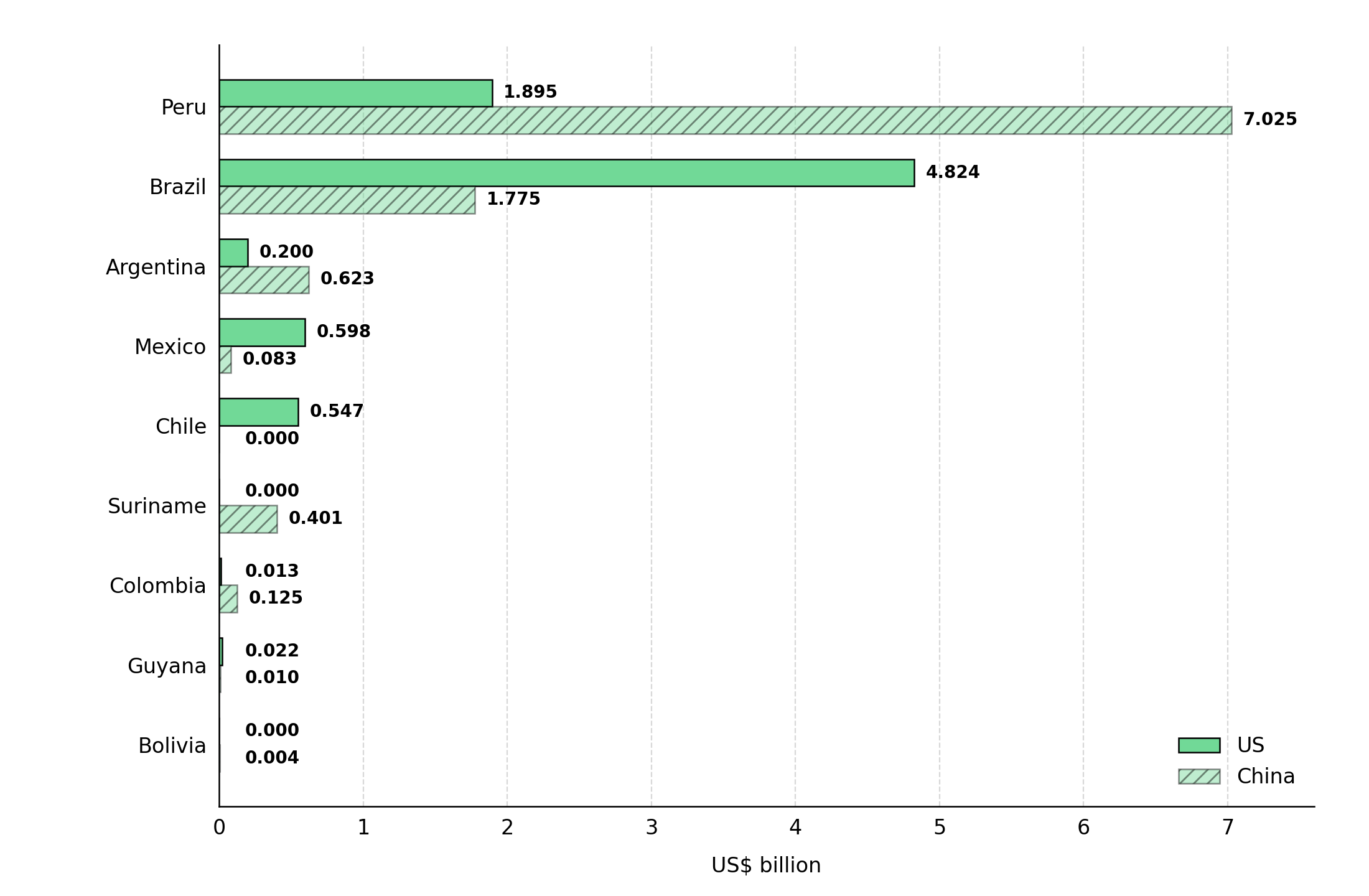
US Capital Overtakes China Since 2022 in Latin American Mining Investment
US mining investment in the region has reached US$4.50 billion since 2022, ahead of China's US$2.77 billion, as Washington pushes to secure lithium and copper through regional supply relationships. The Economic Commission for Latin America and the Caribbean found critical minerals made up 24% of announced mining FDI projects but 42% of announced value between 2005 and 2024. Brazil hosts a US$2.56 billion mining acquisition, while Chinese companies have committed a combined US$1.8 billion to Brazilian copper, gold, and tin projects.
Brazil's Lithium Output Gains Weight as China Absorbs Nearly All Exports
Brazil already produces hard-rock lithium. Its spodumene pricing tracks North Asian benchmarks, so shifts in Chinese demand and conversion capacity feed directly into domestic project economics. Output is projected to rise 23% in 2026 to 63,757 tonnes of lithium carbonate equivalent. Minas Gerais anchors the growth through its Lithium Valley initiative, which launched in 2023 to attract investment and build out the state's lithium value chain.
Tripling Lithium Demand Lifts the Value of Latin American Supply Growth
Latin America and the Caribbean produce around one-quarter of global lithium, and regional output is projected to rise nearly 50% by 2030. Global demand is projected to more than triple through 2040, so exploration and development decisions made during weaker price periods shape how much new supply arrives. The Geological Survey of Brazil maps producing assets, feasibility-stage deposits, and undeveloped resources across Minas Gerais, placing the state's pipeline directly inside the regional growth story.
Lithium Spending Cuts Push Capital Toward Projects With Defined Economics
Critical-mineral investment fell 9% in 2025. Battery-material spending dropped more than 20%, and lithium-focused companies cut investment by around 40%, delaying exploration, permitting, and construction. Brazil is still drawing capital: Minas Gerais announced R$220 million of international investment in lithium refining capacity in February 2026. Projects with credible economics, commercial support, and infrastructure access are best placed to secure funding.
Mine Diversification Outruns Refining, Making Secured Offtake the Route to Market
Mining diversification outside China is advancing faster than refining, so Brazilian projects depend on a clear route into existing conversion capacity. Lithium Ionic ($LTH) holds binding five-year offtakes with Yahua Group and Grand Chen for Bandeira spodumene concentrate, carrying a US$1,000-per-tonne floor with no ceiling and a supporting pre-payment facility.
Blake Hylands, Chief Executive Officer of Lithium Ionic, explains why processing growth is tightening lithium supply:
"The capacity and refiners that are being built now are being built in the scale of five to 10 times the current consumption or capacity. These expansions don't take 10 years in China. They can move very quickly."
Infrastructure and Capital Leave Execution as Brazil's Deciding Lithium Variable
Minas Gerais is investing in electricity distribution and high-voltage capacity under Lithium Valley. Combined with established hard-rock production, Chinese market access, and rising US and Chinese mining capital, the grid build-out strengthens Brazil's ability to support additional projects. Assets that pair resource potential with commercial agreements, infrastructure access, and defined development plans are positioned to convert the pipeline into supply.
Which Projects Stand to Gain as Capital Turns Selective
Western capital is flowing into Latin American mining, yet Brazilian lithium still clears through Chinese converters while sector spending contracts. Funding is likely to concentrate on Minas Gerais projects holding secured offtake, grid access, and credible economics, rather than on resource size alone. Re-rating follows as financing and construction milestones turn resources into tonnes, with delivery of Brazil's projected 2026 output gain the nearest measure.
Read more: US-China Mining Capital Race Highlights Brazil’s Growing Lithium Pipeline
Disclosure: This article features Lithium Ionic as a company example. Lithium Ionic had no influence over the topic, thesis, or conclusions of this article, and exercised no editorial control over its content. Yahua Group and Grand Chen are referenced as offtake counterparties for context only; Crux Investor has no business relationship with Yahua Group or Grand Chen.