

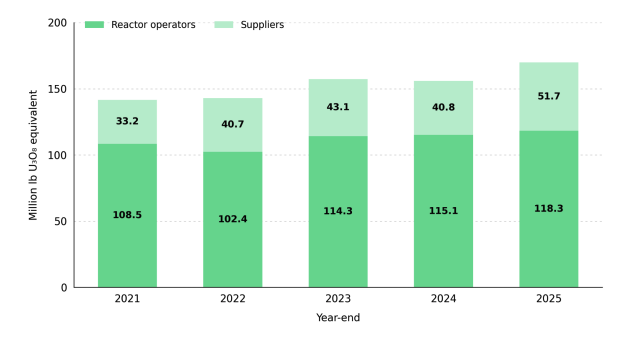
US commercial uranium inventories rose 9% to 170 million pounds at year-end 2025, giving utilities room to defer purchases, according to the US Energy Information Administration (EIA). Yet utilities reported up to 186.3 million pounds of unfilled requirements for 2026-2035, and new mines typically take 15 to 20 years to develop. Inventories shift procurement timing; they cannot shorten mine development.
Supplier-Held Stock Drove the Build, Limiting What Utilities Can Access
Reactor operators owned 118 million pounds, up 3%, while suppliers owned 51 million pounds, up 27%. Supplier material may be committed elsewhere or still in processing, so the total is not all uncommitted concentrate. Operators bought 16% less for 2025 delivery, but one year of lighter buying does not signal weaker demand later in the decade.
Open Requirements Climb Through 2034, Putting Pressure on Contract Timing
Existing contracts carry up to 174.1 million pounds of deliveries for 2026-2035; adding unfilled needs brings maximum anticipated requirements to 360.4 million pounds. Unfilled volumes rise from 2.4 million pounds in 2027 to 12.0 million in 2030 and 37.2 million in 2034. These are planning needs, not signed orders, but contracts for those years could give developers revenue visibility for financing.
Reactor Growth Scenarios Need Mine Investment Committed Years Before Delivery
The Nuclear Energy Agency (NEA) and International Atomic Energy Agency (IAEA) put uranium resources recoverable below US$100 per pound of U₃O₈ above 8.1 million metric tons. Reactors operating in January 2025 required about 64,500 metric tons a year; agency scenarios reach 84,800 to 143,900 metric tons by 2050. Contracts must support investment decisions years before that uranium is needed.
Older Contract Prices Cannot Show Whether New Mines Can Be Financed
Long-term contracts supplied 87% of 2025 US deliveries at a weighted-average US$55.91 per pound, against US$76.01 for spot. The 22 new contracts signed in 2025 delivered 4 million pounds that year at US$70.46. Each figure reflects prices paid for 2025 deliveries, not the terms on a new long-term contract that must cover operating costs and repay construction capital.
Uranium Assays Test Whether Drilling Supports Resource Growth
NEA and IAEA reported exploration and development spending above US$1.78 billion in 2023-2024, about 46% above 2021-2022, with no new mining project entering production.
ATHA Energy ($SASK) has traced preliminary uranium mineralization over 1.45 kilometers at RIB North, on its Angilak project in Nunavut, with drilling running through September.
Production, Restarts and Financing Decide When New Uranium Reaches Utilities
US facilities produced about 2.1 million pounds of concentrate in 2025, up from 657,000 pounds, while five operating in situ recovery (ISR) plants held 13.3 million pounds of annual capacity. Capacity alone does not show uranium free for new contracts.
enCore Energy ($EU) keeps South Texas ISR as its production base, with Alta Mesa East, Dewey Burdock and Gas Hills as planned projects, and plans to distribute 35 million Verdera shares as a special dividend on September 30, subject to exchange approvals.
IsoEnergy ($ISO) is combining its past-producing Utah mines, including Tony M, into DISA Uranium, in which it will hold about 33% once the transaction completes. DISA targets an updated Tony M preliminary economic assessment by year-end 2026, while Hurricane in Saskatchewan remains IsoEnergy's development asset.
Atomic Eagle ($AEU.AX) regained a 60% interest in Madaouela in Niger under a new mining convention, giving a framework to seek financing alongside Muntanga in Zambia.
Later-Decade Contracting Would Show Utilities Converting Open Needs Into Supply
EIA's next survey tests whether utilities cover the 23.1 million pounds unfilled for 2031 and 37.2 million for 2034. Lower open volumes alongside stable anticipated requirements would show planned needs becoming scheduled supply.
Deferred Contracting Hands Leverage to the Few Projects Ready to Deliver
Stockpiles let utilities wait. They do not shorten a 15-to-20-year path from discovery to delivery. Each year of deferred contracting for 2031-2034 leaves fewer projects able to meet those dates, and those with permits, funding, and a workable mine plan will command the contracts when buying resumes.
Read full article here: Rising Uranium Inventories Buy Time, but New Mines Typically Need 15-20 Years