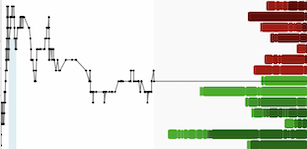


The World Nuclear Association projects that 401 GWe of today's 423 GWe of operating reactor capacity could still be running in 2050, locking in recurring fuel purchases with no new build. Yet US utilities have contracted only 3.151 million pounds of their 36.742 million pounds of anticipated 2033 requirements. The demand is visible; the contracts are not.
Life Extensions Keep 401 GWe of Operating Capacity Buying Fuel
The WNA's September 2026 outlook assumes lifetimes up to 80 years, under which 230 GWe would be 60 to 80 years old by 2050. Performance is not fading: generation hit a record 2,702 TWh in 2025 at an 83.7% capacity factor, with no general decline past 40 years. The Nuclear Regulatory Commission's June 2026 renewal of Edwin I. Hatch Units 1 and 2 runs them to 2054 and 2058.
Refueling Cycles Convert Longer Reactor Lifespans Into Recurring Uranium Purchases
A typical reactor replaces roughly one-third of its core every 12 to 18 months, and that uranium must be mined and fabricated first, so buying runs years ahead of each outage. The OECD Nuclear Energy Agency and IAEA project annual requirements of 84,800 to 143,900 tonnes by 2050, against more than 8.1 million tonnes of resources recoverable below US$260 per kilogram, which is not pounds available for delivery.
Uncontracted 2033 Deliveries Leave Most Future Demand Open to Producers
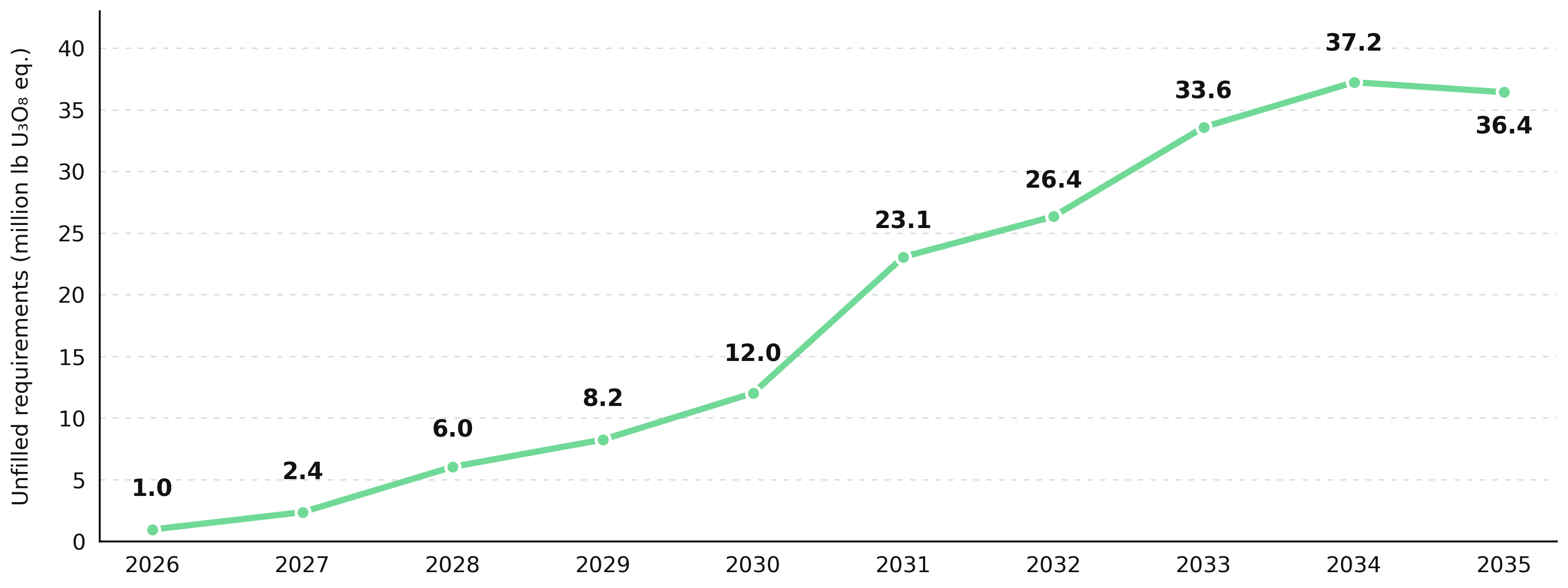
EIA data show 12.021 million pounds of US requirements for 2030 still unfilled at year-end 2025, against maximum contracted deliveries of 17.934 million pounds of uranium oxide equivalent. For 2033, the coverage collapses to 3.151 million pounds contracted against 33.591 million pounds unfilled. The decade's back half is open to whoever signs first.
Long-Term Contracts Price Below Spot and Anchor Producer Revenue Planning
87% of uranium delivered to US operators in 2025 moved under long-term contracts averaging US$55.91 per pound of uranium oxide equivalent, against US$76.01 for spot. European buyers took 13,790 of 14,678 tonnes purchased in 2025 under multiannual agreements. Long-term agreements establish future delivery volumes and pricing terms, which lets producers plan revenue and developers raise finance.
Continuity Across 3.4 Kilometers Builds the Scale Utilities Will Need
Longer reactor lives raise the value of deposits large enough to matter after 2030. ATHA Energy ($SASK) more than doubled the connected mineralized strike at its Angilak project in Nunavut, from 1.45 to 3.4 kilometers, with uranium hit in 21 of 23 drillholes.
81% Recovery at Muntanga East Strengthens the Case for Heap Leaching
Expanding uranium supply depends not only on resource size but on how cheaply the material can be processed. Atomic Eagle ($AEU.AX) recovered approximately 81% of uranium in heap-leach testing at Muntanga East in Zambia, most of it within 15 to 20 days, extending that performance to a new deposit inside its 58.8-million-pound Muntanga project. Scale is what makes heap-leach economics work without a higher price.
34.5% Grade and Pre-Concentration Could Cut Uranium Haulage and Milling Costs
High-grade deposits move less rock per pound, and improved processing can reduce transportation and operating costs. IsoEnergy ($ISO) holds a 48.6-million-pound indicated resource grading 34.5% at Hurricane in Saskatchewan, and its 33% stake in DISA Uranium brings exposure to technology that raised concentration fourfold at 88% recovery. An updated preliminary economic assessment is due by year-end 2026.
Permitted Wellfields Could Add Uranium Pounds Without Building New Processing Plants
Producers with plants already built have the cheaper route to pounds. enCore Energy ($EU) can expand through existing South Texas infrastructure, including Alta Mesa at 1.5 million pounds a year, with its Wellfield 3 Extension awaiting final permit approval and the Upper Spring Creek satellite ready to feed Rosita. Its sales contracts are inflation-adjusted.
What to Watch Before the Contracting Window Closes
Demand through 2050 is close to a given; the pounds behind it are not yet bought. Investors should treat contract coverage as the uranium signal, and favor producers and developers positioned to sign. Rising contracted volumes in the next EIA report are the nearest test.
Read more: Existing Reactor Life Extensions Could Sustain Uranium Demand Through 2050
Disclosure: This article features ATHA Energy, enCore Energy, Atomic Eagle and IsoEnergy as company examples. None of these companies had influence over the topic, thesis, or conclusions of this article, and none exercised editorial control over its content.