

Indonesia produced 66.6% of global mined nickel in 2025, yet the London Metal Exchange (LME) contract requires at least 99.80% purity, leaving much of its lower-purity Class II output outside direct delivery. A Strategic Minerals and Commodities Exchange, operating from January 1, 2027, aims to give Indonesian physical products their own reference prices.
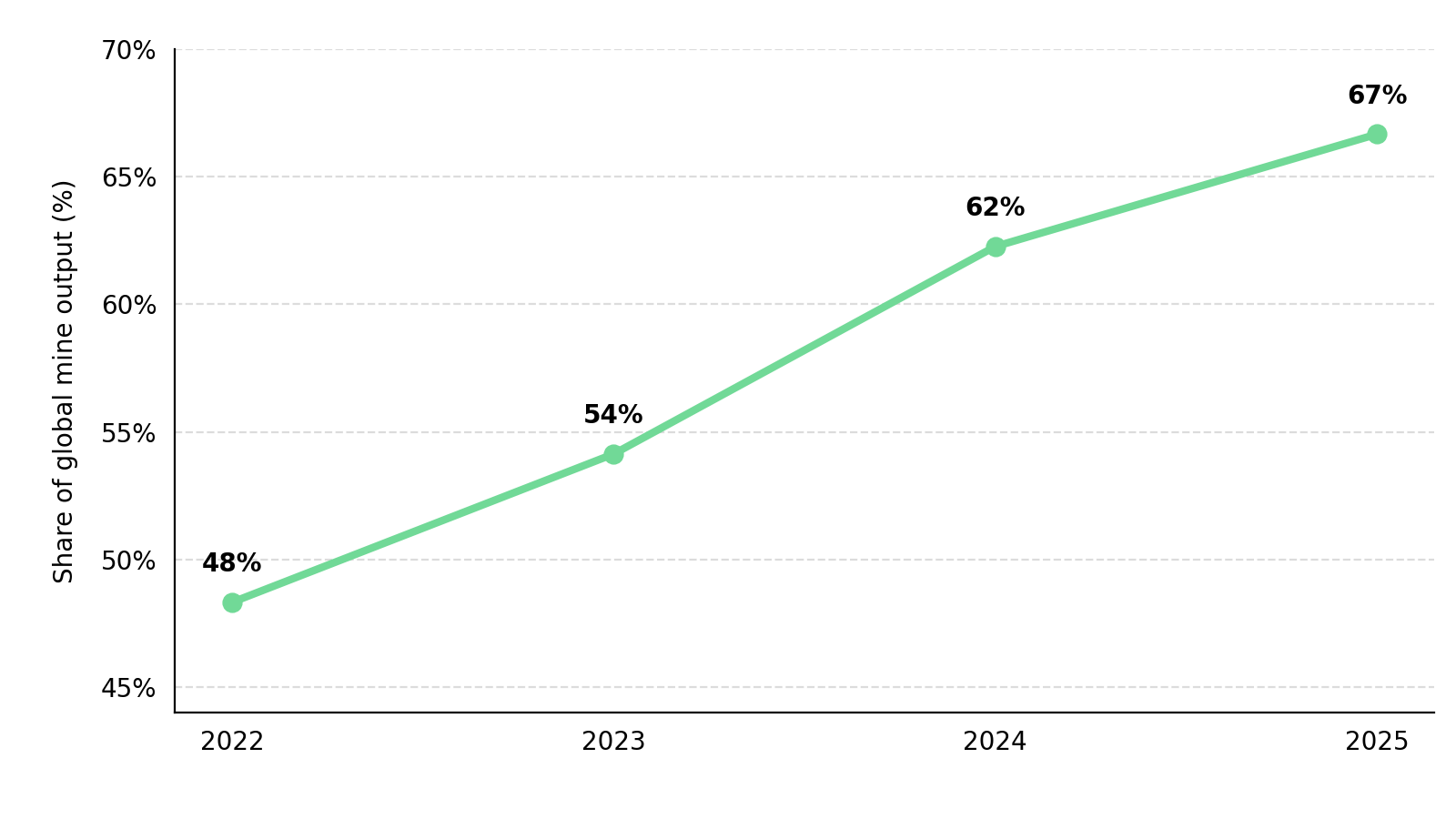
Two-Thirds of Mined Supply Sits Largely Outside the Benchmark Contract
Domestic reference prices would make Indonesian transactions more visible and extend the country's influence over price formation in a market it already dominates by volume.
Quota Policy Already Moves Nickel Prices Before Any Exchange Opens
A plan to cut ore quotas from 379 million tonnes in 2025 to 250 million to 260 million tonnes lifted LME nickel to US$20,000 per tonne in May. Mid-year quota increases and rising ore imports pushed prices back to roughly US$16,500 by September 22. The International Nickel Study Group (INSG) still forecasts a 32,000-tonne deficit in 2026 after a 283,000-tonne surplus in 2025.
LME Purity Rules Leave Stainless-Grade Class II Nickel Without Direct Delivery
Class II products such as nickel pig iron (NPI) and ferronickel feed mainly into stainless steel. NPI can be converted into battery-grade material, but each route carries different conversion costs, so processing route and end-market suitability weigh more heavily on project economics.
Separate NPI Assessments Show Product Form Already Shapes Nickel Pricing
Platts assessed Indonesian NPI containing 10% nickel at US$145.40 per metric ton Free on Board (FOB) Indonesia on August 14. An Indonesian exchange could add observable prices for NPI, ferronickel, and other nickel-bearing products, complementing the LME rather than replacing it.
Liquidity Decides Whether Indonesian Prices Become Benchmarks
Reference prices could feed contracts, royalties, and government pricing formulas, but adoption depends on liquidity, participation, and credibility. President Prabowo has acknowledged buyers can reject prices they consider too high, and thin trading would leave LME contracts and existing assessments carrying greater weight.
Concentrated Supply Growth Raises the Value of Projects Outside Indonesia
Nearly all recent refined nickel supply growth came from the leading supplier. Canada Nickel ($CNC) is advancing Crawford toward a 2027 construction decision, with definitive agreements targeted for the first quarter of 2027 and a modeled US$0.39/lb life-of-mine net C1 cash cost.
Mark Selby, Chief Executive Officer of Canada Nickel, links supply restraint with rising nickel demand:
"With Indonesia limiting supply going forward, and nickel demand growing at 5% plus a year, which is another almost 200,000 tons of nickel per year, we're in great shape. People want supply from somewhere other than Chinese-controlled entities."
Financing Progress Separates Executable Nickel Projects From Resources Still in the Ground
Converting resources into financed projects determines whether supply concentration eases. Lifezone Metals ($LZM.US) has released approximately US$854 million of procurement packages at Kabanga, received multiple strategic equity offers, and targets a final investment decision in the first quarter of 2027.
Ingo Hofmaier, Chief Financial Officer of Lifezone Metals, explains why concentrated supply keeps diversification necessary:
"If you have 65% of market share from one country, that's Indonesia, you need to balance that out. Even if our projects come on, Indonesia will still grow its market share in the next couple of years."
Seven Weeks of Visible Inventory Caps the Price Response to Restraint
Combined LME and Shanghai Futures Exchange refined stocks reached 478,000 tonnes by September 22, roughly seven weeks of global consumption, blunting the forecast deficit. The International Energy Agency projects nickel demand growth of 50% to 90% through 2040, yet transparency alone cannot create physical scarcity.
Product-Specific Pricing Favors Financed, Low-Cost Nickel Supply Built Outside Indonesia
Indonesia mines two-thirds of the world's nickel while the benchmark excludes most of its output, and the 2027 exchange shifts weight toward purity, processing route, and cost position. Elevated inventories cap near-term upside, so low-cost, financed developers outside Indonesia hold relative value first. A broader re-rating follows once rising demand draws down visible stocks as Indonesian supply growth slows. Trading volumes after the January 1, 2027 launch and first-quarter 2027 investment decisions mark the nearest catalysts.
Read more: Indonesia’s Nickel Exchange Could Shift Pricing Across Two-Thirds of Global Supply
Disclosure: This article features Canada Nickel and Lifezone Metals as company examples. Neither company influenced the topic, thesis, or conclusions of this article, and neither exercised editorial control over its content.