

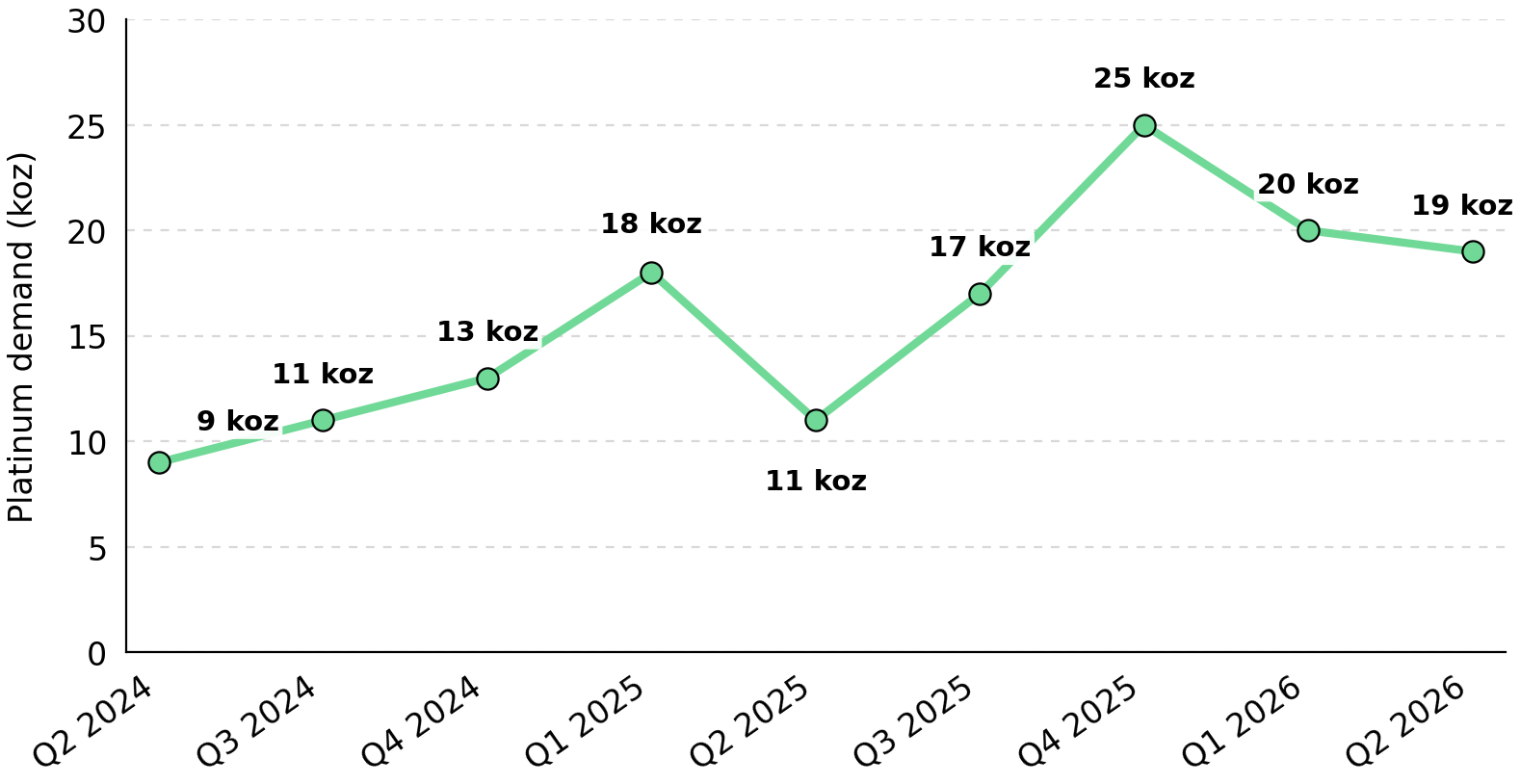
Hydrogen, stationary power and related applications consumed 19,000 ounces of platinum in the second quarter of 2026, up 72% year over year, compared with 729,000 ounces for automotive catalysts. The growth rate is the signal, not the absolute size. Whether this becomes a supply-relevant demand channel depends on which electrolyzer technology actually gets installed, not on how much hydrogen capacity gets announced.
Industrial Demand Growth Broadens Platinum's Base Beyond Vehicle Exhaust Catalysts
The World Platinum Investment Council reported 729,000 ounces of automotive platinum demand in the second quarter, down 6% year over year, while industrial demand reached 600,000 ounces, up 6%. Hydrogen, stationary power and related uses accounted for 19,000 ounces of that industrial figure. Battery electric vehicles carry no exhaust catalyst, so the demand base is rotating toward buyers with different purchase schedules.
Doubled Electrolysis Capacity Does Not Convert Directly Into Platinum Purchases
Installed electrolysis capacity doubled in 2025 to more than 4 gigawatts after several large projects were commissioned, particularly in China. Capacity measures equipment, not metal. Platinum and iridium demand depends on the technology selected, the catalyst loaded into each system, and when the equipment is ordered.
Membrane Choice Decides Whether Platinum or Iridium Captures the Demand
In proton exchange membrane (PEM) electrolyzers, platinum sits at the cathode and iridium at the anode, according to the US Department of Energy. Anion exchange membrane systems can run on PGM-based or PGM-free catalysts, so two projects with identical electrical capacity can consume very different amounts of metal. Palladium has no equivalent hydrogen channel, which means a mixed-metal resource has to be assessed metal by metal.
Fuel-Cell Installations Add Recurring Platinum Demand Where Grid Access Fails
Fuel cells convert hydrogen into electricity at the point of use, with platinum and platinum-alloy catalysts in systems serving critical infrastructure, industrial, security and defense sites where grid access or reliability is constrained. Platinum is bought when catalyst components are manufactured, so recurring demand tracks units produced. Recycling offsets part of that draw on newly mined metal.
Firm Offtake Converts Hydrogen Plans Into Metal Orders
Global hydrogen demand passed 100 million tonnes in 2025, almost all of it in industry and refining, while low-emissions production rose 20% to nearly 1 million tonnes. New offtake agreements covered roughly 1.7 million tonnes per year, but only about 20% of that newly signed volume carried a firm commitment. Equipment deliveries also shift purchases between quarters, and the hydrogen category fell 5% from the first quarter to the second.
Brazil's Pipeline Sits Outside the World's Concentrated PGM Production Base
The Geological Survey of Brazil reports no operating PGM mines in the country alongside deposits at advanced exploration stages, which is why Brazil's PGM deposits offer a pipeline for future supply. Platinum and palladium production is concentrated in a small number of regions, and the exploration case sits in advancing an asset outside that narrow footprint.
ValOre Metals ($VO) is advancing flotation and leaching test work at Pedra Branca, Brazil, with a preliminary economic assessment targeted for the fourth quarter of 2026. Its inferred mineral resource holds 2.198 million ounces of platinum, palladium and gold.
Demand is Widening While New Supply Remains Undeveloped
Platinum's demand base is shifting from vehicle exhaust toward hydrogen equipment. Automotive use is contracting as electric models remove the catalyst, while electrolyzer and fuel-cell demand remains small but growing.
Platinum and iridium are gaining a second demand engine, while palladium remains tied to its established end uses. Commissioned PEM electrolyzers and firm offtake contracts mark genuine progress in hydrogen demand.
PGM assets with proven recoveries, credible economics, and a strong management team carry exposure to widening demand.
Read full article here: Clean Energy Uses Broaden PGM Demand Beyond Vehicle Catalysts
Disclosure: This article features ValOre Metals as a company example. The company had no influence over the topic, thesis, or conclusions of this article, and did not exercise editorial control over its content.