

New free report on my blog: https://open.substack.com/pub/aagresearch/p/iran-the-worlds-fortified-highway?utm_campaign=post-expanded-share&utm_medium=post%20viewer
Summary
This report is the result of a collaboration between me (Alberto Álvarez) and Antonio Ming Rondinella, a military and defense enthusiast. Antonio goes by @trumpeterreport on Substack.
Structure of the report:
Part 1: History of Iran. Written by Alberto.
Part 2: The 2026 Iran war. Written by Antonio.
Part 3: Conclusion. Written by both of us.
This report covers the geopolitics, military, history, geography and economy of Iran and the conflict.
We have not included any way to invest into the war on this report. The reason being that this report is already 50 pages long, and we wish to make this reading as enjoyable and educational as possible. Making it longer would have jeopardized the readability of the report.
About Antonio
Many of you already know me, if not you can read the “About” tab on my blog. Antonio on the other hand is new to Substack. Antonio will introduce himself:
“Hey everyone - I’m Antonio. I’m a rather rare mix in that I’m both an Italian and a Hong Konger, but I consider myself a Westerner first and foremost.
It was around 14 years ago that I discovered I had a great interest in warfare. It has the point where I readily spend as many as 3 hours a day researching and staying up to date with geopolitical affairs. This includes keeping up with the newest weapons procurements and upcoming programs, as well as staying on top of as many ongoing conflicts as I can, while to a lesser degree following the broader news cycle. I majored in International Business, with both a bachelor’s and master’s degree in the field, but my true interest is the realm of defense technology and geopolitics.”
Needless to say I recommend you follow him on his free Substack @trumpeterreport (link). He has not published much yet, but I think you should judge him by his work on this report, which is outstanding.
I would say the 3 hours Antonio mentioned is probably an understatement. He is plugged all day long searching for updates on the wars going on worldwide and the new military technology.
Part 1: History of Iran: The World’s Fortified Highway
Regional Geography
In order to understand a region’s history, one must first comprehend how geography has shaped the local events and peoples. Iran has been the world’s highway for millennia: a route armies, merchants, and ideas would traverse through, but it is also one that exacts a heavy toll and rarely lets travelers remain in control for long.
But why is this?
The reason lies in its geography and topography.
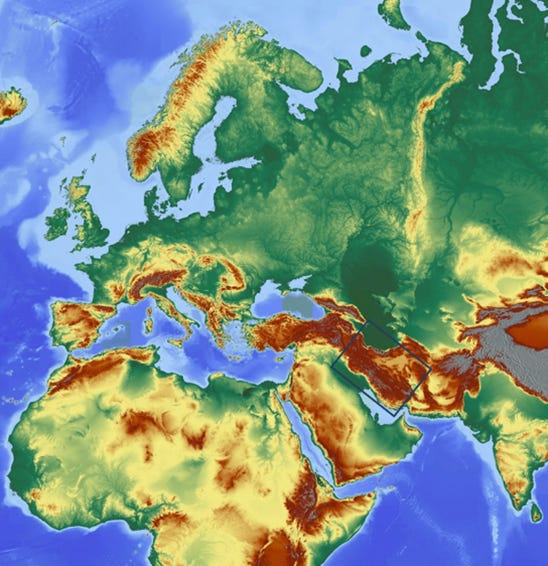
Topographic map. Iran marked as a rectangle (approximately). Red (higher elevation), yellow (average elevation) and green (lower elevation). Mapsland, own elaboration.
Its location is ideal for strategic reasons due to its geography:
To the west: It connects to Mesopotamia (modern Iraq) and the Levant. This means easy access for invasions from the Fertile Crescent.
To the east: Open steppes and passes lead to Central Asia, India, and China.
To the north: The Caspian Sea and Caucasus link to the Eurasian steppes. This was the source of nomadic invasions like Scythians, Turks, and Mongols.
To the south: The Persian Gulf and Strait of Hormuz provide maritime access to the Indian Ocean and Arabian Peninsula.
However, this also makes it a natural fortress:
· Surrounding mountain ranges: The Zagros Mountains in the west form a near impenetrable barrier blocking easy access from Mesopotamia and Iraq. The Alborz mountain range in the north shields it against steppe nomads and invasions from across the Caspian Sea. The other highlands create chokepoints, ambush opportunities, and harsh conditions for large armies.
· Vast plateaus and deserts: The central Iranian Plateau includes extremely dangerous salt flats. This limits maneuverability, water sources, and agriculture for occupying forces while allowing locals to retreat to defensible highlands.
· Rugged coasts and strategic complexity: Southern coasts along the Persian Gulf feature mountains and hidden bases, complicating naval or amphibious approaches.
· Size and dispersal: The country’s sheer scale (over 1.6 million km²) and dispersed population centers render any occupation resource intensive. Invaders can seize cities like Tehran or Isfahan, but holding the countryside drains resources in the long term.
However, if we look at the map above, it should raise an obvious question: Why haven’t armies, merchants and ideas crossed through the north of the Black Sea as opposed to Iran? To the north of the Black Sea are endless flatlands where any number of armies could cross.
While the northern steppe corridor allowed some nomadic incursions, it rarely served as a reliable, high volume invasion highway to the Iranian heartland for several key reasons:
· The route from the north of the Black Sea would require navigating or bypassing the Greater Caucasus range. This is a formidable wall of high, rugged mountains stretching from the Black Sea to the Caspian. Key passes like Derbent (Caspian Gates) or Darial Gorge were narrow, easily defended chokepoints.
· Steppe north of Black Sea and Caucasus: These vast, open grasslands are good for horse nomads (quick raids, mobility). However, they are terrible for sustaining big, slow armies with siege equipment, infantry, and supply trains. No major rivers or roads are available there, unlike in Persia with the Tigris Euphrates corridor.
· Limited population and agriculture: Fewer resources to forage or tax on route compared to fertile Mesopotamia.
In contrast, the Mesopotamian route offered river rich plains which allowed easier movement of armies, resupply via rivers, and access to wealthy cities. It was the “classic” path for conquerors like Alexander the Great (after Gaugamela), the Arabs, Ottomans, and even modern Iraq, which targeted the oil fields in Khuzestan during the Iran-Iraq War. Invaders could seize rich farmlands and trade hubs early, weakening Persian defenses before hitting the plateau.
In short, the northern Black Sea route appears “simpler” on a flat map as a steppe bypass, but it is a nightmarish crossing - a fact that Vladimir Putin was made aware of in early 2022. Ukraine is almost entirely flat, yet Russia has failed to occupy even 20% of its landmass after more than 4 years of brutal fighting which themselves were preceded by 8 years of low-intensity warfare.
The mountains, logistics, defenses, and lack of easy pickings made it far more difficult and less rewarding for invasion and occupation compared to the western/southern “highways” through Mesopotamia. This is part of why the “highway” metaphor holds: Traffic flows where the path is least obstructed, but even then, holding the destination is brutal.
Modern analyses emphasize this: Invading Iran would be “worse than Afghanistan” due to these natural barriers, with experts suggesting a ground invasion to be folly for all but the most determined, skilled foe.
Iran’s History
The Dawn: Kingdom of Elam (c. 2700–539 BCE)
The story begins with Elam, one of the world’s oldest civilizations, emerging around 2700 BCE in southwestern Iran. Elam was centered on the ancient cities of Susa and Anshan.
It was rooted in prehistoric settlements dating back to the 9th millennium BCE. Elam developed as a federation of city states influenced by Mesopotamian Sumerians but distinct in its Elamite language and culture.
The Elamites are generally considered indigenous (native) to the region they inhabited (southwestern Iran), with roots tracing back to the Neolithic period.
The sophistication of the Elamite people is evidenced by their construction of Chogha Zanbil - a massive complex which towered at over 50m in height. Its quality was such that 3200 years later much of it is still standing. At the same time, the surrounding peoples largely remained stuck in the Neolithic.
Elam weathered repeated invasions from Mesopotamian powers like the Akkadians and Assyrians, culminating in the sack of Susa by Assyrian king Ashurbanipal in 646 BCE.
Despite fragmentation and relocation, Elamite artistic and administrative legacies persisted, blending into emerging Iranian identities and laying foundational elements for future polities.
Their first writing system, known as Proto-Elamite, emerged around 3100 BCE. This makes it contemporaneous with (or extremely close to) the invention of writing in neighboring Mesopotamia by the Sumerians. Therefore, when we talk about Iran, we should regard that region as one of the stepping stones in world civilization.
The Rise of Iranian Empires: Median Kingdom (c. 678–549 BCE)
The term “Aryan” (meaning “noble” or “honorable”) was used by ancient Indo-Iranian peoples to refer to themselves.
Aryan tribes migrated into the Iranian plateau in such numbers that by 678 BCE the Kingdom of Elam was no more. In the 7th century BCE these tribes formed the first major Iranian state in western Iran. These Aryan tribes migrated to the Iranian Plateau from the Eurasian steppes of Central Asia and southern Russia and Kazakhstan.
They rebelled against their Assyrian overlords, allying with Babylon and founding an empire that unified tribes from the Zagros Mountains all the way to Central Asia. Median rule emphasized tribal confederations, early Zoroastrian influences, and military prowess.
Note: Zoroastrianism is one of the world’s oldest monotheistic religions, founded over 3,000 years ago in ancient Persia by the prophet Zarathustra. It emphasizes a cosmic struggle between good and evil, urging followers to live by “good thoughts, good words, and good deeds”. In the 19th century Friedrich Nietzsche wrote extensively about Zarathustra.
Though it was short lived, the Median Kingdom was colossal, stretching from modern-day Ankara all the way to the Indus River. It persevered through cultural continuity, with Median nobles integrating into the Persian elite and thereby preserving Iranian linguistic and religious traditions.
From here one will begin to notice that dynasties and kingdoms were replaced constantly. Therefore, the pattern I mentioned will become obvious: Ruling over this land for an extended period is a Sisyphean undertaking.
Another fascinating pattern one may notice is that the conquerors of this land would adopt its customs. These conquerors indulged in Iranian linguistic and religious traditions instead of forcing their own upon the locals.
The Pinnacle of Ancient Persia: Achaemenid Empire (550–330 BCE)
Cyrus the Great, overthrew the Median Kingdom in 550 BCE, founding the Achaemenid Empire: The largest in ancient history, stretching from the Indus River to the Mediterranean Sea. Rulers like Cyrus, Cambyses II, and Darius I implemented tolerant governance, satrapies (provinces), the Royal Road (1,677-mile-long Persian highway), and coinage, while promoting the Zoroastrianism religion.
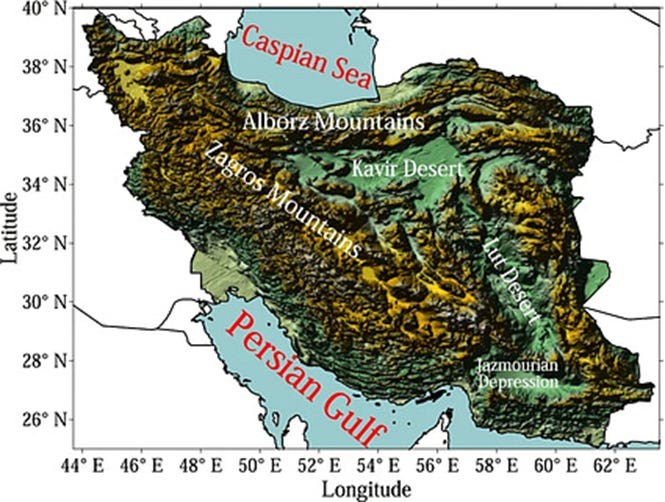
Topographical map of Iran. Tayeb Raziei.
The empire withstood internal rebellions and Greek incursions during the Greco-Persian Wars (499–449 BCE). These wars weakened the Achaemenid Empire which created an opportunity: A Macedonian king wanted it for himself and he seized the moment.
Achaemenid vulnerability coupled with Alexander the Great’s unparalleled strategic acumen saw his 330 BCE invasion succeed brilliantly.
Despite conquest, Achaemenid traditions lived on: Persian administrative models influenced Alexander’s successors. Cultural symbols like Persepolis inspired later Iranian revivals, ensuring the “Land of the Aryans” concept persisted.
Hellenic Interlude: Seleucid Empire (330–247 BCE)
Following Alexander’s death in 323 BCE, his general Seleucus claimed Iran, blending Greek Hellenism with local customs in the Seleucid Empire. Greek cities and art flourished, but Iranian resistance grew through provincial revolts.
Revival and Roman Rivalry: Arsacid (Parthian) Empire (247 BCE–224 CE)
The Parthians, a group residing in northeastern Persia, rebelled against Seleucid rule. They then established an empire that controlled the Silk Road and even clashed with Rome.
They crushed the Romans at Carrhae (53 BCE) and influenced regions from Armenia to India. Persian language evolved into Middle Persian, maintaining Iranian identity until overthrown by internal rebels.
The Last Pre-Islamic Glory: Sassanian Empire (224–651 CE)
Ardashir I (from southern Iran) founded the Sassanian dynasty by defeating the Parthians and created a centralized Zoroastrian state that rivaled Byzantium.
Expansions included capturing Roman emperor Valerian as well as briefly controlling Egypt. However, near ceaseless warring against the Byzantines weakened it, leading to their collapse following the Arab Muslim invasions in 651 CE.
Sassanian legacy endured; their art, science, and administration were absorbed into Islamic culture.
This was a key first step toward centralization that would prove catastrophic.
Islamic Transformation: Rashidun, Umayyad, and Abbasid Caliphates (651–819 CE)
Arab forces conquered Persia by 651 CE, imposing Islam and ending Zoroastrian dominance under the Rashidun, Umayyad, and Abbasid caliphates. Notice these were three separate entities succeeding each other, therefore there was little stability even during the time of the caliphates.
This invasion exploited the vulnerable Sassanians, who’d been thoroughly weakened from wars and centralization: Provinces no longer had enough power to resist. Once the capital fell, all was lost.
However, all three Islamic caliphates lasted less than 200 years in total.
Heavy taxation sparked resistance, but Persians adapted by influencing the caliphate through Persian culture. They contributed leaders, scholars, and bureaucracy to the caliphate capital Baghdad. Islamization reached 90% by the 11th century, yet Persian language and customs endured within an Islamic framework.
Note: After this invasion, Iran would no longer go back to its Zoroastrian roots, it would become an Islamic region. Only in the modern day has Zoroastrianism (and atheism) begun to make a comeback.
By the 9th century the power of the Caliph had become symbolic in Iran, Samanids took power from the caliphate and started de facto governing.
The following two dynasties ruled from the 9th century to the 11th century. They were the Samanid and Buyid dynasties, both of which were Iranian. Even though they were weak and did not control much land, they merged Islamic culture with Persian one. Leading to what we know today as Iranian culture.
The Buyid were Shia Muslims (second largest branch of Islam) but Persia did not become Shia just yet.
Turkic Influx: Seljuk Empire (1037–1194 CE)
The Seljuk Turks migrated from South Siberia, Mongolia, and inner Asia. And they invaded Persia in the early 11th century. The invasion itself happened in just 10 to 15 years. This is another pattern I have noticed when reading Iranian history for this report: Invasions didn’t take long, but the invaders were not able to stay in power for an extended period of time.
Note: In today’s terms 10 to 15 years for an invasion may seem like a lot, but a millennium or two ago, invasions routinely took generations to see through. Caesar needed 8 years to conquer Gaul (modern France, Belgium, and Switzerland). Rome needed 200 years to conquer Iberia (modern-day Spain and Portugal).
This was a turning point in Iran’s history as the Turkics would be the dominating force in Iran for the next 1000 years. Different groups of Turks conquered Iran from each other many times during this 1000 years.
The Seljuks established the Seljuk Empire which lasted 150 years. They too were influenced by Persian language and culture.
Pre-Mongol Twilight: Khwarazmian Empire (1194–1220 CE)
The Turkic Khwarazmians came from south of the Aral Sea, in modern day western Uzbekistan, northern Turkmenistan, and parts of Kazakhstan. Even though it took them decades to merge with Persia and take full power of Iran, their empire lasted a mere 26 years! From the year 1194 to 1220.
This was the last Iranian state with Persian courts.
Devastation and Adaptation: Ilkhanate (Mongol Rule, 1256–1335 CE)
The following years were horrific. Genghis Khan’s (non-Turkic) 1219 invasion razed cities, killing millions. In less than 3 years the Mongols toppled the Empire. However, local Mongol rulers converted to Islam, adopting Persian ways. Despite horrors, Iran’s endurance came through cultural assimilation, and just like the occupiers before them, the Mongols didn’t stay long, even with their military prowess. In just 80 years the Mongols fell in Persia.
Timurid Empire (1370–1507 CE)
The Timurids (whose founder, Tamerlane, was himself a distant descendant of the Mongols) were invaders from Central Asia’s steppe routes and in the 14th century they conquered Persia from the Mongols. The death toll is staggering, probably in the hundreds of thousands. However, once again these invaders were absorbed by Iranian culture
Shia Unification: Safavid Empire (1501–1736 CE)
Shah (meaning king) Ismail I (Turkic) reunified Iran in the early 16th century. He imposed Shia Islam on Sunni Ottomans and Uzbeks. The Safavids centralized power which shaped modern Iran. And from this moment onwards Iran would remain Shiite.
Note: The main branches of Islam are Sunni (comprising roughly 85–90% of Muslims) and Shia (10–15%). Their relationship is often strained by political, rather than purely theological, differences.
Shia and Sunni Muslims share core beliefs in the Quran and Prophet Muhammad; however, they differ primarily on leadership succession after the Prophet’s death in 632 CE. Sunni Muslims believe leaders (Caliphs) should be elected, while Shia Muslims believe in a hereditary line of infallible Imams from Muhammad’s family.
Transitional Warriors: Afsharid Iran (1736–1796)
Around 1722 Ottoman (Turkic) and Russian forces seized Iranian land. Russia took swaths of Iran’s Caucasian territories, while the neighboring Ottomans invaded from the west. A new Iranian warlord (Nader Shah) seized this opportunity and took power from the weakened Safavid dynasty.
Modernizing Monarchy: Qajar Dynasty (1796–1925)
After the death of Nader, Iran plunged into decades of anarchy and tribal conflicts. Many regions seceded and a new leader emerged: Agha Mohammad Khan.
Agha Mohammad’s life was characterized by hardship; he was castrated as a child and imprisoned for 16 years. However, through relentless, brutal military campaigns he defeated his enemies and reunited those regions that had seceded (such as Georgia).
Most notably, Agha moved the capital to Tehran, which he fortified and expanded.
Iran suffered through many invasions while under Qajar rule: two Russo-Persian wars (due to Russian advances), the Anglo-Persian war of 1856 (occupying parts of the Persian Gulf, like Kharg Island), World War I occupations and Ottoman incursions. Overall, the Qajar era is marked by territorial loss. Vast swathes of the Caucasus were taken by Russia while the Qajars were forced to renounce their eastern claims due to British pressure.
Secular Monarchy: Pahlavi Dynasty (1925–1979)
Reza Shah Pahlavi rose to power in the early 1920s primarily due to the weakness of the Qajar dynasty. He also had great military ambition which resulted in a 1921 coup he organized. The coup also received significant external backing from British officials.
The 1953 coup (Operation Ajax): The CIA, supported by Britain’s MI6, orchestrated a coup against democratically elected Prime Minister Mohammad Mosaddegh, who had nationalized Iran’s oil industry (previously controlled by British interests).
This reinstated the Shah as an absolute monarch, marking a pivotal US intervention to prevent perceived communist influence and secure Western oil access. The US government has since acknowledged its central role. After the 1953 coup, the US provided substantial financial aid, military assistance, and training for Iran’s security forces. This included helping establish and train SAVAK - the Shah’s notoriously brutal secret police.
Iran became a key US ally in the Middle East, buying massive amounts of American weapons (Nixon’s “Twin Pillars” doctrine). This supported US positions in Vietnam and against Soviet expansion and ensured Gulf stability after Britain’s withdrawal in 1971.
The economy flourished, with thousands of Americans working in Iran and many Iranians studying in the US. The Shah was seen as a pro-Western bulwark, though his regime’s repression fueled widespread domestic resentment.
Theocratic dictatorship: Islamic Republic of Iran (1979–Present)
The Pahlavi dynasty (1925–1979) brought significant progress: rapid industrialization, infrastructure projects (roads, railways and universities), massive education expansion, economic growth (especially oil-fueled), land reform that benefitted peasants, women’s suffrage, legal rights (divorce, custody), and freedoms like dress choice; many women wore Western styles without hijab mandates.
Nevertheless, the Islamic Revolution happened. It is pertinent to ask why:
During the Shah’s rule, the opposition united diverse groups: secular leftists, nationalists, liberals, intellectuals, merchants, students, workers, and crucially, Shia clerics and their adherents.
In the mid-1970s, about 34% of the Iranian adult population was aged 15–24, and roughly 45% of the population was under 15 years old. Young people have the energy needed for a revolution.
Note: This is a common ingredient found in most revolutions. You need energy and a high risk appetite to succeed. Therefore, a young population is paramount. Even during the American Revolution this was the case; Jefferson was 33 and Hamilton 21 years old when the Declaration of Independence was signed.
The government in Iran was unpopular. The state’s repressive actions, doled out by SAVAK, were a source of discontentment. Economic inequality was acute despite vast oil wealth. Rapid Western-style modernization alienated traditional and religious segments of the population. Corruption too was rampant, and there was a lingering perception of foreign puppeteering. This last point became clear after the 1953 CIA-backed coup.
The Shah aggressively modernized Iran but ruled with an iron fist. He himself was a symbol of the nation’s inequality, living lavishly while the masses were stricken by inflation and unemployment.
Khomeini channeled this popular resentment into an Islamic revolt from his exile in France. Once the Shah fled, Islamists outmanoeuvred his allies, purged moderates and leftists. They then imposed a strict theocratic regime (mandatory hijab, curtailed freedoms) and turned Iran into the Islamic Republic that exists to this day. They reversed many Pahlavi-era liberties in the name of “Islamic purity” and anti-imperialism.
Ayatollah Ruhollah Khomeini was exiled in 1964 for opposing the Shah’s reforms, however, he became the revolution’s unifying figure from abroad. His fiery cassette tape sermons, distributed via mosques, condemned the Shah as a tyrant and puppet of the West, framing resistance in Islamic terms.
Mass protests escalated from 1977–1978: Strikes crippled the economy (especially the oil sector), demonstrations faced brutal crackdowns and the military’s loyalty eroded. The Shah fled Iran on January 16th, 1979. Khomeini returned triumphantly on February 1st, 1979, to massive crowds.
By February 11th, armed revolutionaries overwhelmed loyalist forces, toppling the Shah’s regime. The Islamist faction consolidated power post revolution through strategic manoeuvring: Khomeini purged leftists and moderates and used referendums/institutions to establish the Islamic Republic under clerical supremacy. The hostage crisis (1979-81) radicalized the regime further, rallying support against the West.
Such inward purges are common in history. Revolutionaries often devour each other once the revolution succeeds. The French and Russian revolutions are good examples of such purges.
Ending chapter
The Shia Islamist clergy and their supporters who took power in 1979 were the first in about a thousand years to do so without the backing of Turkic tribal forces
The revolution was overwhelmingly an urban, nationwide Iranian movement centered on Shia religious networks, bazaars, students, and workers; not tribal or ethnic militias.
Virtually every dynasty that ruled Persia since the 11th century, came to power with the backing of Turkic tribal forces, while using educated Persians in their bureaucracy. The 1979 revolution broke from it entirely.
It was an ideological and religious movement (Shia Islamism), it was mass based, and anti-monarchical; not a tribal conquest. The power shift came from popular mobilization and clerical networks, not nomadic warriors. The break from the 1,000-year pattern of Turkic tribal military backing means Iran’s power transition is now driven by mass mobilization forces rather than nomadic conquests.
What it means for Iran to break with this 1000-year-old trend:
· Greater fragility and unpredictability: Without tribal warrior loyalty as a stabilizing “sword,” regimes rely on ideological control, the Revolutionary Guards, and security apparatus. When ideology and repression lose legitimacy, as seen in repeated protests, the system cracks more easily through popular unrest, economic collapse, or elite infighting.
· Demographic reversal weakens revolutionary fuel: The youth helped topple the Shah, but Iran has undergone one of the world’s fastest fertility declines. The population is aging rapidly.
· Persistent internal challenges: Ethnic minorities (the largest group at 15–30 million) no longer serve as conquerors but as potential sources of fragmentation or demands for rights.
· Current trajectory (2026): Iran faces acute economic woes (high inflation, sanctions, currency collapse), fresh nationwide protests, regional setbacks (weakened proxies), and succession questions after aging leadership.
Iran has faced roughly between 8 and 12 major foreign conquests in over 4,000 years of recorded history, plus many smaller incursions. It has also suffered about another 10 revolts from insiders which led to regime changes.
While this is a high number, it is not the absolute highest globally, India for example has been invaded around 200 times. However, as time has passed the duration of each regime in Persia and Iran has shortened. This has happened all over the world too, but in Iran it has been particularly troublesome. For example, since the 16th century they have gone through 6 separate political entities. While most other countries have gone through one or two.
Since the 18th century (when the US was founded), Iran’s political systems have lasted an average of 66 years each. This is remarkable and highlights the point of this section: Invading Iran is difficult but controlling it for long periods of time is almost impossible.
Part 2: The 2026 Iran War
Glossary
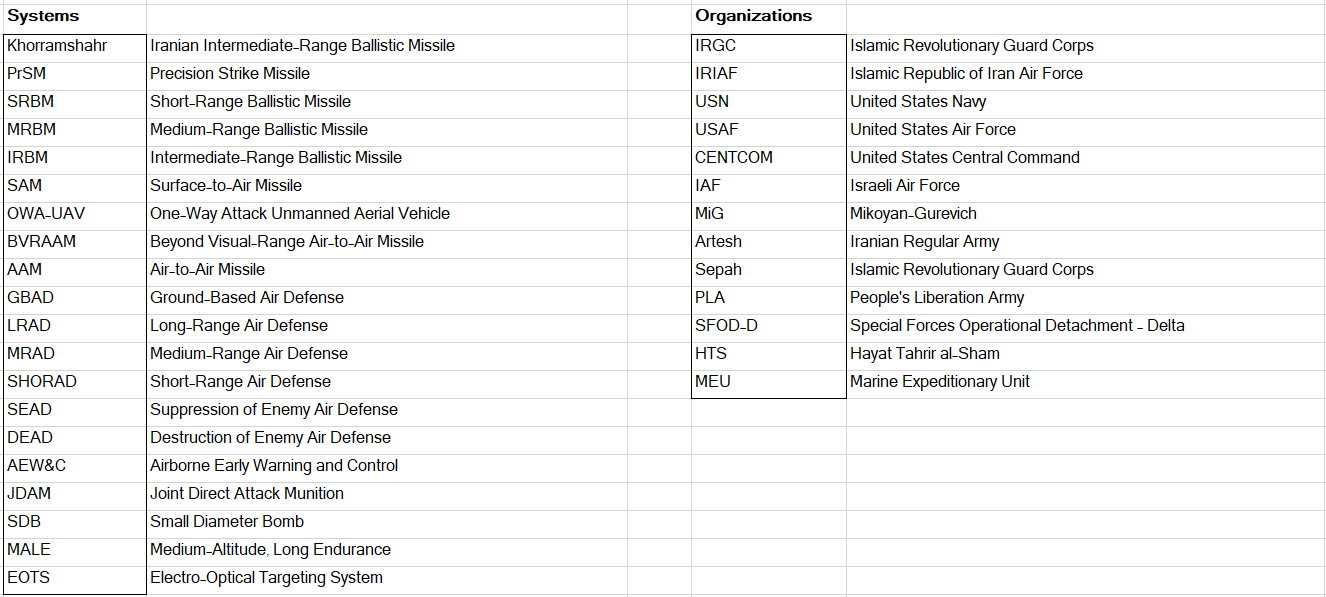
Order of Battle
Before delving into the war, it would be handy to describe the disposition of forces on both sides. It would be neither useful nor desirable to list absolutely every system in service on each side and state how many are in existence, as this only lends itself to a superficial analysis. Rather, I will talk about the differences in fighting style, and highlight individual platforms when relevant. For example, I will refrain from listing every combat aircraft in the US arsenal or how many they have, as this does nothing for you, the reader. Instead, I shall discuss (broadly) US and Iranian doctrine while pointing out how certain systems such as the F-35 on the US side and the Khorramshahr on the Iranian side fit into this.
Iranian Strategy
Iran’s military is large and divided into 2 main branches: the Artesh, and the Sepah. The Artesh is the regular military; the unmotivated grunt sitting at a kiosk waiting for the day to end is in the Artesh. The committed ideologue bringing suitcases filled with cash to Hezbollah is in the Sepah. The Sepah refers to the Islamic Revolutionary Guard Corps, or IRGC. Several Middle Eastern nations possess such a force; Saddam Hussein’s Iraq famously had its Republican Guard. The Sepah is the more “elite” component of the Iranian security apparatus: a large, comprehensive palace guard whose ranks are made up of true believers of the Islamic Republic.
The existence of the IRGC is in large part due to the autocratic nature of the country, where one of its main purposes is to protect the government from being deposed by the regular army, the Artesh. As such, they possess much of their own, separate equipment, with perhaps the most notable example of this being the IRGC having its own navy. One might think that such separation causes inefficiency, and yes - this belief would be correct. However, this reveals yet another key doctrine of Iran and nations similar to it. Namely, allowing the government to remain in power is the single most important mission the country has; every other consideration must give way to it, and so inefficiency is tolerated if it otherwise bolsters the government’s hold on power.
The longstanding sanctions on Iran have largely prevented it from being able to assemble a modern military in the way the Chinese have been able to (though it’s likely their army would’ve resembled the Russian one more so than the PLA). This has resulted in the Islamic Republic of Iran Air Force (IRIAF) continuing to fly geriatric aircraft such as the American F-5, or more famously, the F-14 Tomcat: an American twin-engine naval interceptor that was retired from US Navy (USN) service in the 2000s! Several of these were destroyed by the Israeli Air Force in June 2025, and as one might expect, the US has been in no mood to supply Iran with spare parts for their American airframes since the Islamic Revolution.
As such, scant few of their US-made aircraft were airworthy even prior to the 12-Day War in 2025. Arguably, Iran’s most advanced multirole aircraft is an aging variant of the Russian MiG-29 Fulcrum which has not been competitive since Desert Storm; those air forces that continue to fly it do so out of necessity, not desire (Ukraine being the clearest example of this). Iran also lacks capable air-to-air missiles for any of its aircraft. It’s unlikely any of the AIM-54 Phoenix BVRAAMs (beyond visual range air-to-air missile) they received in the 1970s are still usable, and Iran never received any R-37 or R-77 BVRAAMs from Russia.
At the same time, any prospects of modernization have fallen short. Russia has failed to deliver 24 relatively advanced Su-35 twin-engine air superiority fighters that they were contracted for, and China has not sold Iran any of its sophisticated J-10C single-engine fighter jets (along with the deadly PL-15E air-to-air missiles they’d sport), contrary to what certain outlets were promulgating in the wake of the 12-Day War. This has resulted in the IRIAF being one of the worst equipped, worst-trained air forces in a region where the average air force ought not be underestimated.
The Iranian navy too is relatively inconsequential, lacking advanced large surface combatants and relying on a small number of Russian Kilo-class diesel-electric submarines for subsurface warfare, as well as a so-called asymmetric strategy of using drone motherships, small speedboats, and missile boats to presumably attack US naval battlegroups. Delving into their navy is by now an entirely moot point as the majority of it has been sunk or rendered inoperable.
Iran’s ground forces are numerous, yet the same could’ve been said of Venezuela, who boasted (on paper) over 4 million members in its national militia, none of whom so much as raised a finger when fewer than 200 American SFOD-D (otherwise known as Delta Force) teams fought their way through Venezuelan leader Nicolas Maduro’s Cuban security detail and brought him back to the US in irons. The more salient point, however, is that the average Iranian soldier is poorly trained, unmotivated, and his loyalty to the regime is questionable at best. The Iranian government itself demonstrates precious little faith in its conventional armed forces, best evidenced by their lack of response to the Hayat Tahrir al-Sham (HTS) militant group marauding across Syria in a lightning campaign in late 2024, resulting in them deposing the Assad government: a key Iranian ally whose absence now allows Israeli strike aircraft to transit Syrian airspace on their way to Iran unimpeded. The IRGC is a somewhat different beast, though war, especially modern war, is a monumentally difficult undertaking. Competence is unduly assumed of most militaries (largely due to the world seeing the US military make modern war appear easy) when only very few are truly deserving of that descriptor.
As an aside, I personally believe Assad’s downfall to be one of the most underrated aspects of this war. Syrian forces, in particular their elderly yet dangerous air defense network, would have added a layer of complexity to any Israeli air operation where Iran was the target.
The IRGC would fare poorly in a land war against a competent power, hence why they delegate its prosecution to Levantine militant groups (such as the Iraqi Popular Mobilization Forces and Hezbollah in Lebanon) and other nations entirely. Avoiding a direct attack, particularly from the United States, has long been a priority. For this reason, they have fought the United States and Israel asymmetrically for decades, funding proxies and hostile states to bog them down across the Middle East. This has been referred to as the Ring of Fire strategy by some analysts.
Its goal is twofold: Expand Iranian influence across the region, and attrit the United States and Israel all while contemporaneously keeping their attention off of Iran itself. In the case of the United States, Iran’s goal has been to push them to draw down their presence in the Middle East, allowing the Islamic Republic to fill the vacuum. With regard to Israel, Iran’s ultimate goal is the total destruction of the Jewish state. Therefore, the main objective here has been to surround Israel with enemies. Hezbollah in Lebanon, Hamas in Gaza, the Assad regime in Syria, and the Houthis in Yemen are all part of Iran’s Ring of Fire. This desire is also why Iran is keen on developing nuclear weapons; they would both enable Iran to (in theory) destroy Israel and deter conventional military action from the United States. This asymmetric strategy had served Iran well, as evidenced by the pervasive influence of pro-Iran militant groups inside Iraq which have successfully infiltrated every sector of Iraqi society. This doctrine was also in play during the Red Sea Crisis, where Iranian naval vessels were aiding the Houthi militant group target US warships and commercial shipping vessels. The Ring of Fire was working as intended, until Iran was finally engaged directly.
Iran’s 3 strong points that would serve in a hot war are their ballistic missiles, one-way attack drones (OWA-UAVs), and air defenses. Iran has employed a variety of ballistic missiles, ranging from short-range ballistic missiles (SRBMs) only capable of striking targets a few hundred kilometers away, medium-range ballistic missiles (MRBMs) capable of reaching targets over 1000km away, and most recently intermediate-range ballistic missiles (IRBMs) that could hit western Europe. Before the war started, Iran had a stockpile in the thousands, mostly comprising cheaper SRBMs.
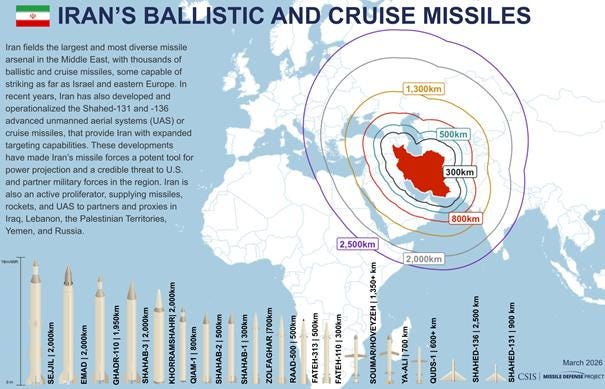
Iranian missiles (not including converted space launch vehicles that function as IRBMs). Center for Strategic & International Studies
However, across all 4 recent conflicts (including this one) where Iran has used its MRBMs and IRBMs, they have demonstrated a shockingly poor degree of accuracy. Though many were intercepted by the US and Israel, those that were not either fell on civilian areas or failed to strike any targets of significance in Israel. This has not changed. Most recently, Iranian use of their new, 2000km-range Khorramshahr-4 IRBMs armed with cluster warheads revealed the spread of said cluster munitions to be embarrassingly wide and entirely useless in a military context. The submunitions were far too small (only a few kilograms apiece), and spread over far too wide a radius to be considered reliable or have any meaningful effect on target. On the other hand, in this current conflict Iranian SRBMs have performed well, mostly hitting their intended targets.
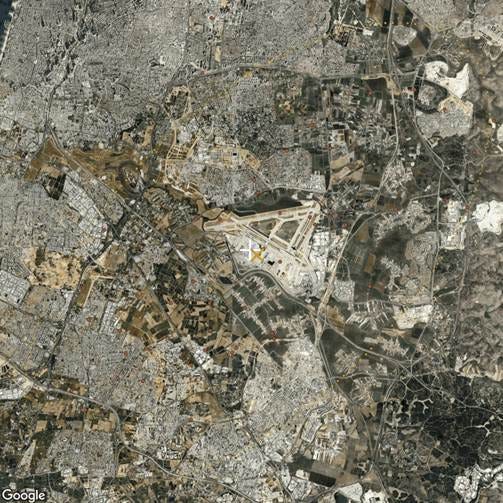
Illustrative Khorramshahr-4 spread (each faint reddish dot is a submunition). Decker Eveleth
Iran arguably pioneered the concept of the long-range OWA-UAV, famously selling Russia thousands of Shahed-136 one-way attack drones and helping them erect a sprawling drone manufactory in Tatarstan. While it could be argued that Russia now possesses a more sophisticated arsenal of OWA-UAVs than Iran such that they are now supplying Iran with drones (and the United States too has entered this contest with their LUCAS drone), Iran’s capabilities in this sector remain threatening and should not be discounted. Such drones are slow, easy targets with relatively small warheads, yet their precision and low cost render them dangerous. These kinetic effectors serve to strike lower-priority targets, and more importantly, saturate enemy air defenses, allowing heavier, more sophisticated, and expensive munitions to get through. It should be noted that this mostly applies to cruise missiles, as the weapons employed against cruise missiles and drones are rarely those used in ballistic missile defense.
Drones such as the Shahed family also tend to be somewhat modular, allowing for different warheads, jammers, or decoys to be installed. Russia has even conducted (largely ad hoc) experiments attaching short-range anti-air missiles to their OWA-UAVs in an attempt to down Ukrainian helicopters sent to intercept them. While they have thus far failed to do so, these missiles are inexpensive and present an undeniable threat to interceptor aircraft (helicopters and propeller aircraft are at the greatest risk). Iran has not yet attempted this, but possesses the tools and knowhow to do so.
Iranian air defenses were not to be underestimated. Outmatched in the air, Iran focused on denying it to the enemy through their use of ground-based air defenses (GBAD). Iran boasted a mix of Russian-derived as well as indigenous designs that have left their mark across the region. Perhaps most notable is the infamous “358”, a so-called loitering missile which, in the hands of the PKK, a marxist Kurdish militant group, has been responsible for the downing of multiple large, Turkish medium-high altitude drones such as the Aksungur. Additionally, Iran had several modern, long-range radar-guided air defense (LRAD) systems such as the Talaash, Arman, Bavar-373, and Russian-supplied S-300PMU2. On paper, each of these systems is optimized to combat aerodynamic threats such as aircraft and cruise missiles at ranges surpassing 100km.
In terms of medium-range air defense (MRAD) systems, Iran famously employs the Khordad-3 (better known as the Sevom Khordad), a tracked platform similar to the Russian 9K37 Buk. In this category, they also utilize several older, less capable systems such as the American MIM-23 HAWK, and Russian 2K12 Kub. While dangerous, these are far less threatening.
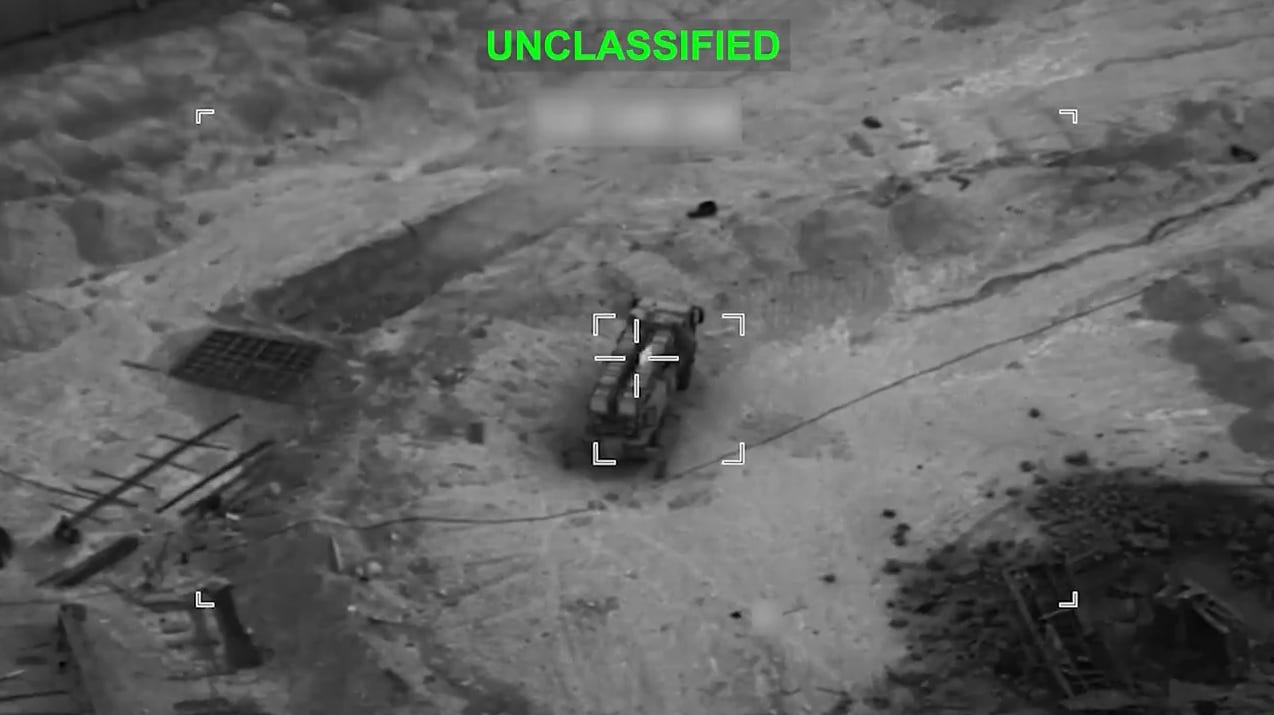
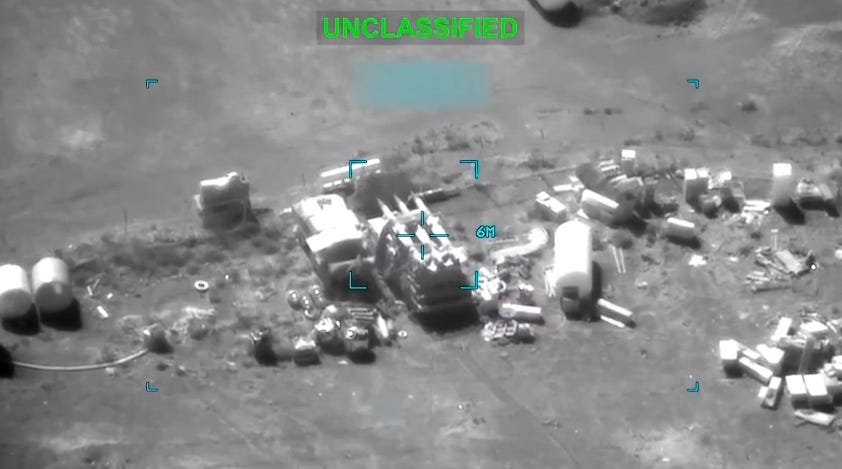
Iranian Talaash (top) and 2K12 Kub (bottom) air defense systems. United States Central Command
Lastly, their short-range air defenses (SHORAD, ranges of <=20km) include weapons such as the Russian 9K330 Tor, and their indigenous Azarakhsh and Majid to name a few. Perhaps counterintuitively, I am of the belief that these SHORAD systems present the greatest threat to US and Israeli aircraft. This is because due to their shorter range, they will be lower on the list of priority targets compared to LRAD/MRAD systems, and will be struck later.
Entire strike missions made up of multiple flights of aircraft might be flown with the intention of neutralizing a single LRAD complex; it is difficult to imagine such energy being devoted toward the destruction of a lone short-range platform. Additionally, systems that fire smaller weapons tend to themselves be physically smaller, and consist of fewer vehicles (LRAD systems are rarely a single vehicle, rather a complex made up of launchers, generators, radars, and control stations) allowing for easier concealment and transport. Finally, these systems tend to employ passive tracking methods - chiefly infrared guidance. Unlike radar-guided systems which emit signals that can be tracked back to the source, SHORAD platforms making use of infrared guidance do not send out easily trackable emissions. As such, weapons like the Majid and Azarakhsh can quickly be unveiled, and if a hostile aircraft happens to be in the vicinity (this does require some luck, as due to their short range, they have a small defended footprint), they can attempt to engage it.
Iran had and still has no reliable ballistic missile defenses to speak of.
US/Israeli Strategy
Since it is the most relevant facet of Western doctrine (especially in this conflict), I will mainly discuss airpower. The US and Israel (henceforth referred to as the Coalition for simplicity) can be lumped into one category, as they largely wage war in the same manner, namely with the focal point being airpower and precision fires. Both nations’ greatest strength is their air forces (in reality it is their “system of systems”, though that is a rabbit hole for another day). This emphasis on airpower exists because controlling the sky is decisive. Mitsuo Fuchida, one of the Imperial Japanese pilots who took part in the attack on Pearl Harbor and the later Battle of Ceylon (modern-day Sri Lanka) in early 1942, stated: “He who controls the air controls the sea, and the world.” These words were true in the Second World War; they remain true today. Ownership of the air allows for the timely observation and destruction of the enemy with relative impunity from the majority of the enemy’s weapons, therefore giving one dominance over the battlespace. More specifically, the Coalition emphasizes precision strike. This is in contrast to a nation like Russia which prefers to use massed fires to solve its problems. This method’s efficacy (or lack thereof) is plainly visible in Ukraine, 4 years, 13,000 wrecked fighting vehicles, and 1.2 million casualties in.
Western doctrine relies on owning the sky. Achieving this is rarely an easy feat, and so great effort is put into the destruction of enemy assets that would attempt to disrupt this mission. SEAD/DEAD, or Suppression/Destruction of Enemy Air Defense, is the first step. This is performed in tandem with the destruction of enemy communications infrastructure and command centers, with the intention of paralyzing the enemy’s military response by blinding and deafening them.
Radars send out emissions that are easily homed in on, and SEAD aircraft - most notably the EA-18G Growler - possess jamming pods such as the AN/ALQ-99 and newer AN/ALQ-249 Next-Generation Jammer (Midband) to disrupt enemy communications and radar. They are then engaged with anti-radiation missiles, which track the origin point of incoming radar emissions. Turning the air defense radar off and then back on has been successfully done in the past, though modern anti-radar missiles such as the AGM-88E will remember the GPS coordinates of the target, making this particular tactic obsolete. These opening strikes will be accompanied by a large salvo of long-range precision strikes using cruise missiles such as the BGM-109 Tomahawk, and ballistic missiles such as the recently debuted PrSM (Precision Strike Missile) to destroy targets deep inside enemy territory.
While SEAD aircraft scour the ground for targets, dedicated air superiority fighters such as the stealthy F-22 and other multirole aircraft such as the F-35, F/A-18E/F, and F-15EX will scan the skies for enemy aircraft. Neutralizing the enemy’s air force is as important as destroying their air defenses, as both pose an unacceptable threat to friendly aircraft. As such, airbases are also a key target. Fuel dumps, aircraft hangars, munitions bunkers, and the runways themselves will be hit with penetrating munitions, both to destroy the aircraft on the ground (thus avoiding having to fight them at all) as well as rendering the airbase itself inoperable.
Air superiority fighters will be “quarterbacked” by an AEW&C (airborne early warning & control) aircraft - a large narrowbody sporting a colossal radar on top. This radar, whose range far exceeds that of any fighter, will both call out as well as confirm enemy targets for the fighters ahead, who will then engage with air-to-air missiles (AAMs). The AEW aircraft also serves as a “battle manager”, directing the overall flow of the air engagement. Those fighters without stealth shaping and radar-absorbent coatings will often rely on onboard jamming pods, such as the Angry Kitten introduced for American F-16Cs, to jam enemy missiles and aerial radar. This is to say nothing of the various additional, unsung assets that perform tasks such as offboard jamming (EA-37B, various ground stations jamming enemy satellites, etc.) and ever-present fleets of aerial refueling aircraft, or tankers, keeping the strike aircraft airborne both before and after the combat.
Once hostile air defenses have been degraded and the airspace is considered sufficiently permissive, strike aircraft will be able to venture further into enemy airspace. This allows the air campaign to shift to cheaper, short-range precision weapons - chiefly the American JDAM, or Joint Direct Attack Munition, which is a guidance kit that turns dumb bombs into guided bombs. Much the same can be said about the Small Diameter Bomb (SDB), a low-cost penetrating guided weapon that is smaller, yet longer-ranged than the JDAM family. Employing these tools allows far more targets to be serviced, as producing JDAMs and SDBs is far cheaper and less complex than producing large quantities of sophisticated long-range weapons like the stealthy AGM-158 cruise missile. JDAMs and SDBs will be fired at any ground targets that are discovered - armored vehicles, fighting positions, command posts, production facilities, missile launchers, and more.
Main Events
Operation Epic Fury as it was named by the United States, began on February 28th with the first blows struck by the United States in tandem with Israel. It is entirely possible the Coalition would’ve been content to delay H-Hour for several more days if not weeks; the aerial refueling tanker airbridge and surge of US airpower to the region continued well into the war’s opening days. However, it’s likely that Coalition intelligence discovered an opportunity they couldn’t turn down: a meeting of what effectively amounted to the entire upper echelon of the Iranian state apparatus, both military and civilian. What followed were dozens of Israeli strike aircraft turning the site into a crater, with Ayatollah Khamenei, the head of the Islamic Revolutionary Guard Corps, and defense minister all killed in the blasts among dozens of others.
Next came what could only be described as a textbook display of Western airpower doctrine: a systematic dismantling of the Iranian military from above. First on the list: air defenses. A modern air campaign necessitates the neutering of ground-based air defenses (SEAD/DEAD) so that strike aircraft can conduct sorties unmolested. The Israeli Air Force, second only to the United States in this regard, did so successfully in the 12-Day War back in June 2025, losing no manned aircraft in the entire conflict.
This ability had been hinted at in their prior skirmishes with Iran. Notably, their surgical strike on a very rare, very valuable Russian-supplied 30N6E Flap Lid radar belonging to an S-300PMU2 long-range air defense system back in 2024 (destroying its radar effectively bottlenecks an LRAD and renders it useless). This also meant that Iran’s air defenses were far from full-strength when the hostilities began once more in 2026. Against the combined SEAD capability of the US and Israel, this was a foregone conclusion. Both Central Command (CENTCOM, the US’ combatant command responsible for the Middle East Area of Responsibility) and the Israeli Air Force (IAF) released video after video showing various precision munitions destroying a smorgasbord of short, medium, and long-range Iranian air defenses whilst themselves incurring no losses. Simultaneously, as the path was being cleared, more strike aircraft struck command and control sites, and also engaged in what is often called Scud Hunting: seeking and destroying ground-based, mobile ballistic missile launchers. Once again, the Americans’ aptitude in this domain has only improved since the Gulf War. Their success in this mission has been evidenced by the dramatic fall-off in Iranian ballistic missile launches as the war has continued; they have gone from several hundred in the first 2 days of the war to no more than a few dozen per day.
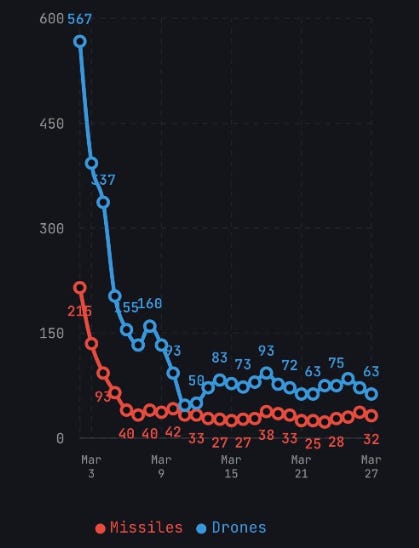
Daily Iranian ballistic missile and drone launches. Dmitri Alperovitch
As air defenses were degraded and ballistic missile launches declined, the Coalition (chiefly Israel) began to go after Iran’s state security agencies. This included strikes against the IRGC, of course, but also the Basij, Iran’s morality police. While it is hard to precisely gauge the damage done to these organizations, given Israel’s extensive intelligence penetration of the Iranian state it is safe to assume the damage has been severe. The Israeli Air Force released several videos showcasing them targeting Basij personnel on the ground in Iran, and according to the Wall Street Journal, hundreds of Iranian security personnel were killed when they inexplicably decided to gather in a football stadium in Tehran.
By this point, Iran’s ability to produce (not launch) ballistic missiles and large drones has largely been annihilated in the most literal interpretation of the word. Not only have the plants performing final assemblies been destroyed, but also just about every facility involved in their ballistic missile supply chain. Propellant, seeker, and casing manufacturers have all been successfully targeted.
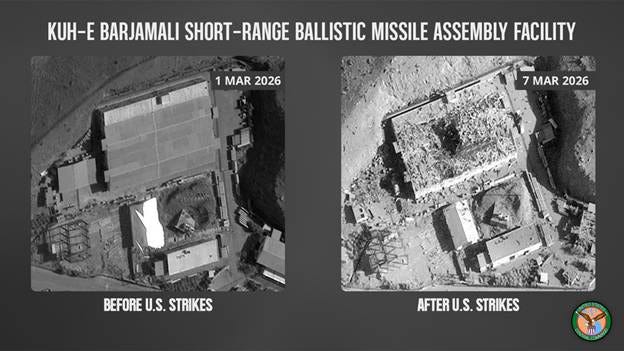
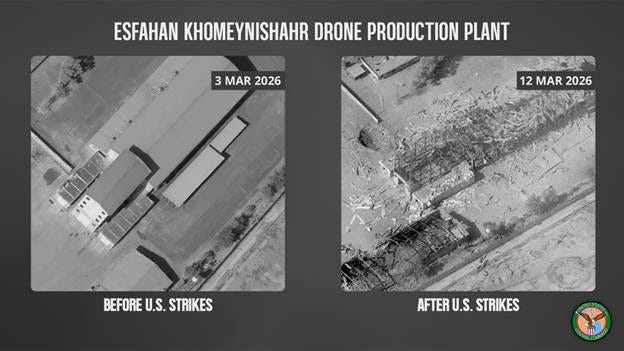
Examples of US strikes on Iranian munitions production facilities. United States Central Command.
Iran’s response was, for lack of better terminology, to fire anything and everything - at everyone. One would naturally expect their ire to have solely been directed at the United States and Israel. Not so. Iranian SRBMs, MRBMs, and OWA-UAVs poured onto soft targets across the entire region. While Israel did come under attack from hundreds of IRBMs (mostly targeting civilian infrastructure), a similar number of ballistic missiles rained down across the Gulf. Videos of drones and missile interceptions over Gulf cities such as Dubai, Abu Dhabi, Manama, and notably, Doha, flooded the Internet. Iran’s targeting choice here was revelatory. Though a scant few missiles did strike Gulf oil infrastructure and empty US bases across the region (the strike on the US Navy’s 5th Fleet HQ in Bahrain comes to mind), with 2 missiles even targeting but failing to reach the US base on Diego Garcia in the southern Indian Ocean, the majority of Iran’s response was directed toward civilian targets: apartment complexes, hotels, shopping malls.
Gulf Trepidation
Iran’s motivation for striking at civilian areas in the Gulf is clear. The Gulf states are conflict-averse nations. Yes, they have collectively spent hundreds of billions of US Dollars building their armed forces; until recently, the Qataris were flying a more sophisticated variant of the F-15 multirole fighter than even the United States! However, these militaries were never intended to fight an actual war (though now that they are at least partially doing so, these investments have paid off). The weapons shopping sprees embarked upon by countries like Qatar were in large part vanity projects. Collecting diverse fleets of advanced 4th Generation fighter aircraft was always an incomprehensible fool’s errand to the educated observer and a waking nightmare for the logisticians of the nations in question. The reason they did so (other than money) is the same reason why the Gulf states have gone to great lengths to cultivate tourism, sporting talent, and even space programs: prestige.
Prestige in this context can be taken to mean a nation’s standing in the world, and this is a fragile thing. Both the very extensive, very valuable oil infrastructure, as well as the image of luxury these nations painstakingly built, are easily shattered. Were this near-existential danger to be realized, it would have been entirely plausible for them to lobby the United States and Israel to pursue a ceasefire that would’ve simply reset things to the status quo ante bellum. Iran knew this, hence their attacks on Gulf energy and tourism. This was a gamble - a gamble that spectacularly failed to pay off. Not only has Iran hardened the Gulf’s resolve (according to the New York Times, Saudi crown prince Mohammed Bin Salman has been doing the opposite of what Iran wanted, lobbying the White House to keep the pressure on), which now likely views the Iranian regime as a threat to be removed, but it has also alienated one of Iran’s closest allies and gateways to the wider world: Qatar. Mere days into the war, the Qatari state media agency, Al Jazeera, announced that several IRGC sleeper cells had been arrested in Doha. It wasn’t long after that that Qatari F-15s downed a pair of Russian-built, Iranian-operated Su-24 Fencer bombers. This is, to be quite frank, a stunning departure from what had been thought possible in the leadup to the conflict. In spite of all this, I refer to my earlier statement about the Gulf being conflict-averse; they have yet to join the war in any offensive capacity. In all likelihood, however, it will make little difference.
Coalition Airpower
Coalition aircraft have put up astonishing numbers: nearly 1500 targets serviced on day 1 alone, and over 12,000 sorties (air missions) as of March 26th (disclaimer: it is entirely possible this number refers to targets serviced, though that would change little as the outcome is the same). This means that 2 nations have, by themselves, given Desert Storm’s rates a run for their money with approximately half the aircraft: a testament to the efficiency of modern airpower. This comprehensive strike campaign has progressed relentlessly, and continues apace as of the time of writing. Around day 3 was when the USAF began employing strategic assets. B-2 stealth bombers, their internal weapons bays packed with 2000lb bunker-busting GBU-31 JDAMs, hit underground targets across Iran. It would not be long before the B-52s and B-1Bs were called upon as well. Their work was evident on satellite imagery; multiple Iranian underground missile bases and manufactories had been damaged or destroyed. Notably, the non-stealthy B-1Bs were seen in the UK being armed with JDAMs (Joint Direct Attack Munitions, short-range GPS-guided bombs). The implication is clear. The Coalition had, within days, achieved air superiority over large swathes of Iran such that slow bombers and even MALE (medium-altitude, long endurance) drones like the Israeli Heron and American Reaper could loiter without disruption, joining the hunt for Iranian ballistic missile TELs (transporter-erector launchers) with their short-range Mikholit and AGM-114 Hellfire missiles. Already on day 1, a significant percentage (if not the majority) of Coalition strikes were being conducted with short-range guided bombs like the Israeli SPICE, and American JDAM and SDB (Small Diameter Bomb) families of weapons. The presence of Coalition aircraft inside Iranian airspace, a fact vociferously denied by Iranian propagandists, was once again reinforced when an IAF F-35I scored the model’s first ever air-to-air kill on a manned aircraft against an Iranian Yak-130 light fighter. The Israelis would later publish footage of the shootdown recorded using the F-35’s AN/AAQ-40 Electro-Optical Targeting System (EOTS). Around week 2, Coalition air superiority became even more undeniable when non-stealthy US Navy F/A-18E/F Super Hornets were seen overflying the southeastern Iranian port city of Chabahar at low level on various occasions.
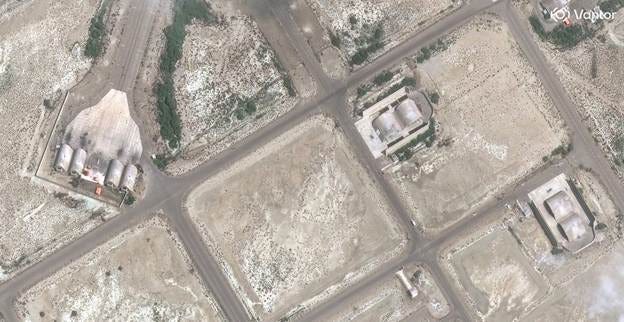
8 Hardened Aircraft Shelters (HAS) in Iran, each likely hit by a single GBU-39 Small Diameter Bomb. Vantor Holdings.
Days into the campaign, the United States had also begun sinking the Iranian Navy. Most ships were sunk in or near port, with CENTCOM publishing multiple videos of Iranian warships being targeted. Yet the Silent Service (the USN’s submarine force) was also able to partake, marking its first kill since WWII, and the 2nd ever kill for a nuclear submarine (the first being the sinking of the Argentine ARA Belgrano by HMS Conqueror during the Falklands War in 1982) when the USS Charlotte, a Los Angeles-class nuclear attack submarine, sank the Iranian frigate IRIS Dena off the Sri Lankan coast on March 4th. The IRIAF, largely a nonfactor from the outset, has also been pummeled by Coalition strikes. The IAF had already seen to much of its destruction last year; this has only continued in 2026. Iran was never going to be able to contest the air and sea domains, especially since the rumors of them receiving Russian and Chinese Su-35s and J-10Cs respectively were just that. Even so, their presence would have served mostly as a training opportunity for the Coalition to familiarize themselves against advanced PLAAF aircraft. This, of course, assumes they weren’t simply destroyed on the ground as would’ve almost certainly been the case. The United States is largely uninterested in facing off against enemy aircraft in the sky despite their unparalleled competence for air-to-air warfare; they much prefer to strike them before they can take off.
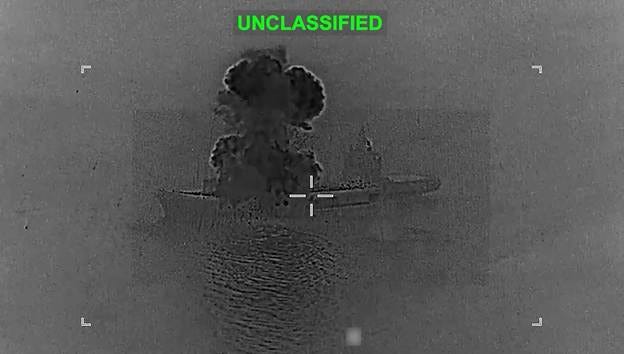
The IRIS Shahid Bagheri, Iran’s flagship drone carrier, ablaze after a US strike. United States Central Command.
Iran’s missile campaign would soon confusingly expand in scope, targeting even more uninvolved countries. A USN Arleigh Burke-class guided missile destroyer had to down an Iranian ballistic missile that would’ve landed in Turkey (as of the 28th, this happened 3 times). 2 Iranian OWA-UAVs struck civilian targets in Azerbaijan. Iranian drones would also set ablaze several storage tanks at an oil depot in Oman: the nation which had facilitated US-Iran negotiations prior to the war’s outset to no avail. Some have posited that, following the degradation of their command-and-control in the opening stages of the war, individual battery commanders simply decided to loose their weapons upon whichever country they personally had a grievance with. Whether there is any truth to this claim, I leave that to the reader. As an aside, I believe the Americans’ intention was to use the talks as a façade to begin with so as to obfuscate the otherwise very clear motivation of their massive buildup of forces in theater.
Coalition Losses
Statistically, there was virtually no chance of the Coalition escaping unscathed this time around. This was clear to the planners of Desert Storm; it is clear today. The sheer volume and complexity of Coalition air operations meant that at some point, something was bound to go awry, and it did. The most noteworthy incident was the downing of 3 USAF F-15E Strike Eagles by a Kuwaiti F/A-18C Hornet. The incident took place within visual range, leading to speculation that the act was perpetrated intentionally. For what it’s worth, I am also of this belief, as I see no plausible explanation for the pilot not only failing to identify 3 friendly aircraft on 3 separate occasions, but also failing to realize his mistake after the first shootdown. No US aircrew were killed, however, and it is probable the Kuwaiti government will reimburse the US for the loss of 3 expensive F-15E airframes (around $100mln apiece).
Additional Coalition losses include 6 US servicemen killed on the ground in Kuwait after an Iranian strike. More recently, a USAF KC-135 Stratotanker aerial refueling aircraft went down in western Iraq following a midair collision with another Stratotanker, likely while one was refueling the other. All 6 aircrew on board perished and the surviving airframe suffered damage to its vertical stabilizer. 2 other incidents include a fire breaking out on the USS Gerald R. Ford supercarrier, with 2 sailors seriously injured as a result and the destruction of numerous sleeping quarters on board, as well as some minor shrapnel damage to 5 and destruction of 2-3 US tanker aircraft on the ground at Prince Sultan airbase in Saudi Arabia. That such occurrences are taking place on the Ford is unsurprising; the carrier has now engaged in 2 large-scale military actions without returning to port as originally scheduled. Crew fatigue, combined with general wear and tear, will reap their toll. Finally, an unknown number of Coalition MALE drones such as the US MQ-9B have been lost over Iran; these are unwieldy, non-stealthy, slow platforms and it is no surprise that they have suffered losses. It’s possible upwards of 20 have been downed thus far, though Coalition planners broadly consider such assets to be expendable during major operations.
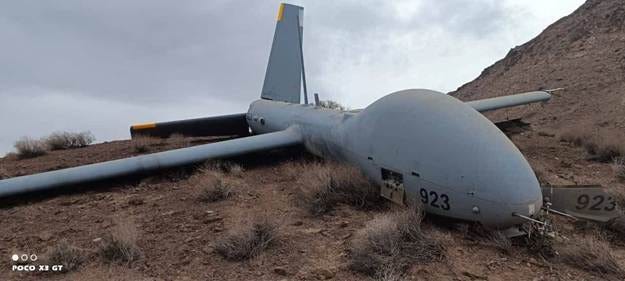
A downed Israeli Hermes drone in Iran. Source unknown
To put these losses into perspective, one should look no further than Desert Storm itself. Desert Storm is widely considered one of the most successful and devastating military campaigns in history. It saw the near complete destruction or surrender of Iraqi forces in Kuwait to the point where US aircrew were directed to spare Iraqi forces fleeing Kuwait out of concern for the pilots’ mental wellbeing. Furthermore, air defenses inside Iraq as well as the Iraqi air force suffered catastrophically, with multiple instances of Iraqi pilots fleeing, with their aircraft, into Iran, against whom they’d recently fought a war. Thousands of tanks, armored vehicles, and heavy weapons, as well as tens of thousands of Iraqi soldiers, were killed or captured. And yet, even in that campaign the Coalition lost around 300 men killed and 75 aircraft downed, and it should be mentioned that approximately half of these were due to accidents or friendly fire.
Iranian Successes
Iran’s strategy, on the other hand, has seen paltry military successes. It is true that Iranian munitions did strike US bases across the Gulf. The aforementioned 5th Fleet headquarters. Al Dhafra in the UAE. Al Udeid in Qatar. Ali al Salem in Kuwait. Erbil Int’l airport in Iraqi Kurdistan. What all of these locations have in common is that they were largely vacant of strike and support aircraft. The US was well aware of Iran’s stockpile of SRBMs, which far exceeded their supply of more expensive IRBMs. As such, they concluded that defending their forward bases was (for the most part) futile, and would simply result in the fruitless expenditure of countless missile interceptors. As such, US airpower has largely been sortieing from bases further afield. Ovda and Ben Gurion in Israel. Muwaffaq Salti in Jordan. Prince Sultan in Saudi Arabia (it’s believed the Saudis have not greenlit the use of their bases to stage combat missions, so Prince Sultan is only populated by support aircraft such as tankers and AEW&C. This is in addition to the USS Ford in the Red Sea, and USS Abraham Lincoln in the Arabian Sea. These aircraft carriers serve as mobile airbases that can exploit the most valuable layer of the survivability onion: Don’t be there. This strategy has been successful; only Prince Sultan, the base nearest Iran out of the group, has been hit, with little damage. Iran has (falsely) claimed to have downed a multitude of US strike aircraft; their sole partial success (thus far) was achieving a glancing hit on a US F-35, which nonetheless made it back home. It’s likely this was the result of a SAMbush (a pop-up attack with surface-to-air missiles, or SAMs) using a small, short-range air defense system employing infrared or electro-optical guidance (as opposed to radar guidance, which is what the aircraft is primarily designed to evade), which is always a risk.
Iran’s major success has in fact been its disruption to the global economy through their war on Gulf oil and gas. Additionally, their closure of the Strait of Hormuz, the narrow waterway into the Arabian Sea that tanker ships rely upon to ferry petroleum out of the Persian Gulf, has spiked energy prices enormously. Even so, Iran has been largely incapable of enforcing this closure militarily, with only isolated incidents of tankers coming under attack from one-way attack drones (both naval and aerial types). Rather, it seems skyrocketing insurance rates have been a more intimidating foe in this regard. The US has hitherto declined to escort ships through the Strait. This is a tactically sound plan, as doing so would put valuable US warships at risk. Other nations such as India and Pakistan have both begun to do just that, though far below what would be necessary to consider the Strait reopened; the number of tankers passing through the Strait has been negligible. Other nations have warships nearby on counter-piracy missions that could easily be re-tasked. These include South Korea, Japan, and several European countries involved in the Aspides freedom of navigation operation in the Red Sea. Whether this takes place is purely a matter of will, not capability, though based on statements issued by said European nations, the will to do so is sorely lacking. Given French President Emmanuel Macron’s declaration to escort vessels “once hostilities subside”, one could not be blamed for betting that Europe will remain uninvolved for the remainder of the conflict.
Objectives
Coalition Aims
The objectives on both sides are very simple. There are no complex outcomes that one side or the other is aiming to achieve. The Coalition wishes to depose the Iranian regime. Whether this takes the form of a popular revolt that sees the Islamic Republic ousted, the regime itself surrendering and the Ayatollah (whoever that may be by that point) abdicating, or simply bombing whoever is next in line until a figure emerges whom the Americans deem amenable and malleable to their wishes (this is what occurred in Venezuela, with that figure being acting president Delcy Rodriguez). Barring that, defanging Iran for the foreseeable future is the option that makes the most sense. Destroying their military, nuclear program, missile and drone programs, and as much of their government as possible to keep them off the geopolitical chessboard for the coming years (ideally decades). This is because the United States is gearing up for a war against the People’s Republic of China in the Pacific, and a hostile Iran that takes advantage of that war to strike at US interests in the Middle East would be decidedly suboptimal. Defanging Iran in this manner would not be difficult to achieve and is already being implemented, as doing so involves many of the same steps that would theoretically usher in regime change. Several large transport aircraft employed by the regime to ferry resources to their proxies across the Levant have already been struck. A multitude of facilities involved at every level of the drone and missile supply chains have been leveled. Companies with ties to the Iranian defense sector too have had their buildings airstruck, including 3 separate steel plants across Iran. Such assets are neither cheap nor easily replaced. The Coalition could easily go further by striking Iranian oil infrastructure (the Achilles’ heel of the Iranian economy), as well as civilian power infrastructure. Doing so would, at least temporarily, spike oil prices. Destroying anything tends to be cheaper than building it, and 2000lb JDAMs are inexpensive yet superlative tools of destruction.
In this vein, the deployment of a Marine Expeditionary Unit (MEU) to the region may have as an objective the seizure of Kharg Island, a small Iranian island in the Persian Gulf from which the vast majority of Iran’s oil is loaded onto tankers and exported. The Coalition recently struck targets on Kharg, and one may wonder why the Coalition does not simply annihilate the oil infrastructure present, as it was intentionally spared. It is entirely possible that the Coalition wishes to take and use Kharg as a bargaining chip if Iran proves intransigent and unwilling to end the war once the Coalition’s other objectives are complete (of course, this assumes the most desirable goal of deposing the regime has been deemed unrealistic). Alternatively, the target may be an island or a section of Iran nearer to the Strait itself, with the landing’s objective being that of reopening the Strait. This would, in my opinion, make more sense. Kharg is in the heart of the Persian Gulf; the MEU would need to transit the Strait itself and venture deep into the Gulf, a risky maneuver, to reach it. It is more likely that islands nearer the Strait itself would be targeted, with the intention being that of holding the waterway open by threatening Iranian forces on the coast that would seek to interdict transiting vessels. The Marine Corps has gotten little action (relative to the Air Force and Navy) thus far, and is champing at the bit to get stuck in.
Iranian Aims
Iran’s goal is even simpler. Survival. Given the overwhelming superiority in fires the Coalition enjoys, if this war ends with the current government still in place, they will consider it a victory. The regime is aware that a military victory in the traditional sense, where the enemy’s ability to wage war is removed, is off the table and will thus shift to making this war unpalatable for the broader public in the United States. They will attempt to do so by inflicting an unacceptable level of casualties on US servicemen, as well as through economic means such as closing off the Strait of Hormuz. The US public is largely indifferent to the government’s overseas endeavors as long as casualties remain low, but is highly sensitive to energy costs; the state of the economy is arguably the top issue for the average American voter and the party that goes into election day responsible for a floundering economy should skip the anticipatory champagne. The White House is well aware of the fact that when Americans go to the polls in November, they will assuredly factor in plummeting 401Ks and soaring gas prices when they cast their ballots. As such, Iran partially hopes to force the White House to pull the plug on the war out of concern for their prospects in the Midterm elections.
Where do we go from here?
Whereas the objectives on both sides are easy to elucidate, predicting the future is not. What is clear is that the Coalition prepared for a campaign that would last weeks, and months if necessary. At the earliest, this conflict will wrap up around early to mid-April. But wars only end when both sides admit that they end. Rome famously refused to sue for peace even after their crushing defeat at Cannae despite the custom (and expectation from the Carthaginians) at the time being to do just that. While Rome under Scipio the Younger’s sage guidance subsequently won crushing victories in Iberia (culminating in the Battle of Ilipa, which permanently ended Carthaginian influence in the peninsula) and later defeated Hannibal at Zama, there is effectively no chance of Iran pulling off a similar military comeback.
That said, if Iran continues to fire dozens of loitering munitions across the Gulf every single day, the war cannot be considered ended. It could very plausibly still be raging at the end of July, for instance! Purely militarily, this has been one of the most one-sided campaigns in history, possibly even more so than Desert Storm. However, a military victory is not the same as a political victory, and the White House wants prices at the pump to be manageable in the leadup to November. Both sides have presented mixed signals, but neither side has (thus far) presented demands that even approach acceptability for the other.
I have also been asked, repeatedly: “Will there be a ground invasion?” I don’t see how this is at all realistic. Now, as with all things, I could be wrong, and the US could indeed decide to mass what would effectively amount to the entire US Army and Marine Corps to invade and occupy Iran. The preparation for this by itself would take several months, plus several months to conquer Iran. However, there is currently no indication whatsoever of this being in the works, and believe me, there absolutely would be. The treacherous nature of Iran’s mountainous terrain was explained at the beginning of this report; invading and occupying Iran would require a host larger than the one Russia has deployed in Ukraine at this moment (that is to say, in the region of 700,000 troops). The US would almost certainly need to reinstate the draft to accomplish this. There are stirrings of some US land forces being deployed to the region, yet these total significantly fewer than a division element - not all of whom would even be deployed. At most, they could occupy small sections of Iran’s southern coastline and/or islands in the Strait of Hormuz. Alternatively, they will support a SOF (special operations forces) mission to secure high value targets or assets, such as the enriched Uranium in Iran’s possession.
President Trump enjoys a frankly astounding level of fealty from today’s Republican party; a full-scale invasion would see said Republican party openly rebel against his presidency. He would be fortunate to escape impeachment. This is to say nothing of the guaranteed, crushing, self-inflicted loss that this would cause in the midterm elections, the sheer scale of which would be such that the Democrats might even be handed a supermajority in Congress. President Trump himself has stated in no uncertain terms that such protracted land wars are something he seeks to avoid. Regime change would be ideal for the Coalition, but it isn’t their end-all be-all; avoiding a second Afghanistan is a far higher priority than toppling the Islamic Republic. As stated earlier: There are alternatives to total regime change, and the US simply cannot afford to get bogged down in a land war in West Asia when it is staring down the barrel of a civilization-defining Pacific grudge match within the next 10 years; if you were to ask me personally, I think China could make a move on Taiwan as soon as 2029!
Neutering the Islamic Republic militarily for the next decade, if not more, will serve. It is far likelier that President Trump simply declares victory when the tasks pertaining to this goal are completed, and then negotiates a ceasefire, which would necessarily involve the Strait of Hormuz remaining open (I would be surprised if the Coalition were to end the war with it closed). In this scenario, Iran would be foolish to continue firing missiles and drones across the Gulf, especially since the United States could simply remove its military assets from the region. That being said, it is probable that any ceasefire would be backed up by threat of further violence by the Coalition. Iran’s regime surviving at all would be a victory for them; endangering this victory by continuing to sling OWA-UAVs when the other side has provided you an out would be an act of monumental stupidity.
Personally, an outcome where the Coalition (specifically President Trump) announces its mission to be accomplished, negotiates a ceasefire, and the missiles stop flying, is the one I consider to be the most probable. One ought to remember that, while there would likely be some pain, the US is better positioned than most countries on Earth to simply walk away. They can withdraw their forces to bases outside the Middle East, and don’t rely on the Strait of Hormuz being open, as the US is an energy exporter. When this will happen is far harder to predict, though I don’t see this taking place until early to mid-April at the earliest. The Islamic Regime will probably survive, missing thousands of security personnel and militarily neutered for at least a decade, likely longer. This path simply requires the fewest assumptions of future events, and is what I consider to be the one that we are on track to see. I fully acknowledge that this could be wrong and simply believe this to be the most probable outcome; it is far from the only possible outcome. It could be that the regime is teetering on the brink of collapse, and that in a few more days or weeks, the Iranian people take to the streets once more and together with Coalition airpower oust the Islamic Republic. The United States has publicly stated that there will, at some point, be a signal for the Iranian people to come out in force. However, the massacre of anti-government protestors in January was immense, with the lowest estimates in the tens of thousands, and the highest approaching 100,000 fatalities. This is to say nothing of the tens of thousands that were doubtless imprisoned or incapacitated. It could simply be that a significant percentage of those willing and able to forcibly overthrow the regime was taken off the board in January.
Part 3: Conclusions
No matter how it ends, this conflict will leave a lasting effect on the Middle East, and the globe. The 2026 Iran War is the latest chapter in a 4,000 year story of a fortified highway that armies can cross but rarely hold. Once again, a coalition of outside powers has demonstrated that Iran is relatively easy to devastate from the above; once again, the real question is whether anyone can impose lasting control.
If the Iranian regime escapes annihilation, it will be the first regime in roughly a thousand years to do so without relying on Turkic tribal military backing. That alone marks a historic rupture. However, it will need decades, and tens (if not hundreds) of billions of dollars to rebuild its industry and military. They will likely be even more committed to their nuclear weapons program, regardless of any public statements to the contrary. This implies that at a certain point in the future, Israel will strike them once again, possibly with US assistance.
Survival will have cost the regime dearly: a shattered defense sector, a depleted treasury, and a resentful, tired population that has once more seen the military of its government laid bare. This all began with major popular unrest. After everything that has happened, it is only a matter of time before such events repeat themselves. Whether they are successful, only time will tell. The regime’s likely response will be exactly what history predicts: doubling down on nuclear hedging and asymmetric proxies while tightening internal repression.
For the Gulf monarchies, the war has delivered a painful lesson. Years of diplomatic outreach to Iran and naive presumptions of peace were shattered in a day, and their oil and tourism empires proved to be very attractive, vulnerable targets. Neutral countries have seen how easily the lifeblood of the global economy can be dammed up by a rogue state. Expect determined efforts to build strategic petroleum reserves, diversify energy sources, and general pushes for strategic and resource autonomy.
For the United States and Israel, the campaign has been a military success on a scale that rivals Desert Storm. The key difference is that the crushing military victory of Desert Storm was followed by the achievement of the Coalition’s stated objectives. In this campaign, it is likely the most desirable objective of overthrowing the Islamic Regime will not be achieved. Iran has been defanged for a decade or even more, but the highway remains open. The underlying geography, the enduring Iranian identity, and the pattern of short-lived external control have not changed.
The next round (whether it comes from within Iran or from a new external actor) is already on the horizon. In the end, the 2026 war may be remembered less as the conflict that finally broke the Islamic Republic and more as the latest reminder that conquering the Iranian Plateau is difficult, but holding it has always been nearly impossible. The fortified highway endures, its current owners bloodied, but for now, still in control.
Any feedback is more than welcome in the comments, or you can send me a message on Substack or through my twitter (X) account @AAGresearch.
You can contact Antonio on his Substack @trumpeterreport.
I hope this finds you well.
Disclaimer: I assume no liability for any and all of your actions, whether derived out of or in connection with this information or elsewhere, and you hereby warrant and represent that any and all actions that you take or that you may take at a later date in connection with this information shall remain your sole responsibility and, in case, I shall not be held liable for any such actions.